Cutting lists for pork, lamb and beef: what to ask for
A cutting list, or cutting sheet, tells the butcher how to turn your carcase into meat: which joints, chops and steaks you want, how thick, on or off the bone, what goes into mince or sausages, what gets cured, and how it’s packed and labelled. Write it before the kill, because each part of the carcase can only be cut one way.
What a cutting list covers
Some abattoirs and butchers have their own cutting form, and others take instructions by phone or email. Either way, they need the same decisions from you:
- Joints: on the bone or boned and rolled, and roughly what weight.
- Chops and steaks: how thick, and how many to a pack.
- Trim: whether it goes into mince, sausages or burgers.
- Curing: bacon and gammon, smoked or unsmoked, if they offer it.
- Extras: offal, bones, fat, the head and the trotters.
- Packing: vacuum packed or bagged, and what goes on the label.
Send your list when you book the kill, or soon after, and agree it before cutting day. The carcase hangs first (see how long to hang meat), which gives you a little time, but nobody can undo a cut.
How to fill in a cutting sheet
- Start with your kitchen. Joint and pack sizes should suit how many you feed. AHDB’s pork cutting guide suggests 250 g packs of mince or dice for two people and 500 g for four.
- Go part by part. Give one instruction for each part of the carcase, such as “loin: chops” or “belly: half slices, half streaky bacon”.
- Use numbers. Give joint weights in kg and thickness in cm. The same AHDB guide cuts pork steaks 20 mm thick, a sensible starting point for chops. Ask for 2.5 cm or more if you like steaks pink in the middle.
- Decide on the trim. Whatever isn’t a joint, chop or steak becomes mince, sausages or burgers. Ask about minimum batches, flavours and gluten-free sausages.
- List what you want back. Liver, heart, kidneys, bones, fat, the head or the trotters. If it isn’t on the list, don’t count on getting it.
- Say how to pack it. AHDB’s specifications pack steaks and chops in twos. Ask for every pack to be labelled with the cut, weight and date.
- Ask if you’re unsure. Tell the butcher how you like to cook and ask what they’d suggest.
Pig cutting list: a half or whole pig
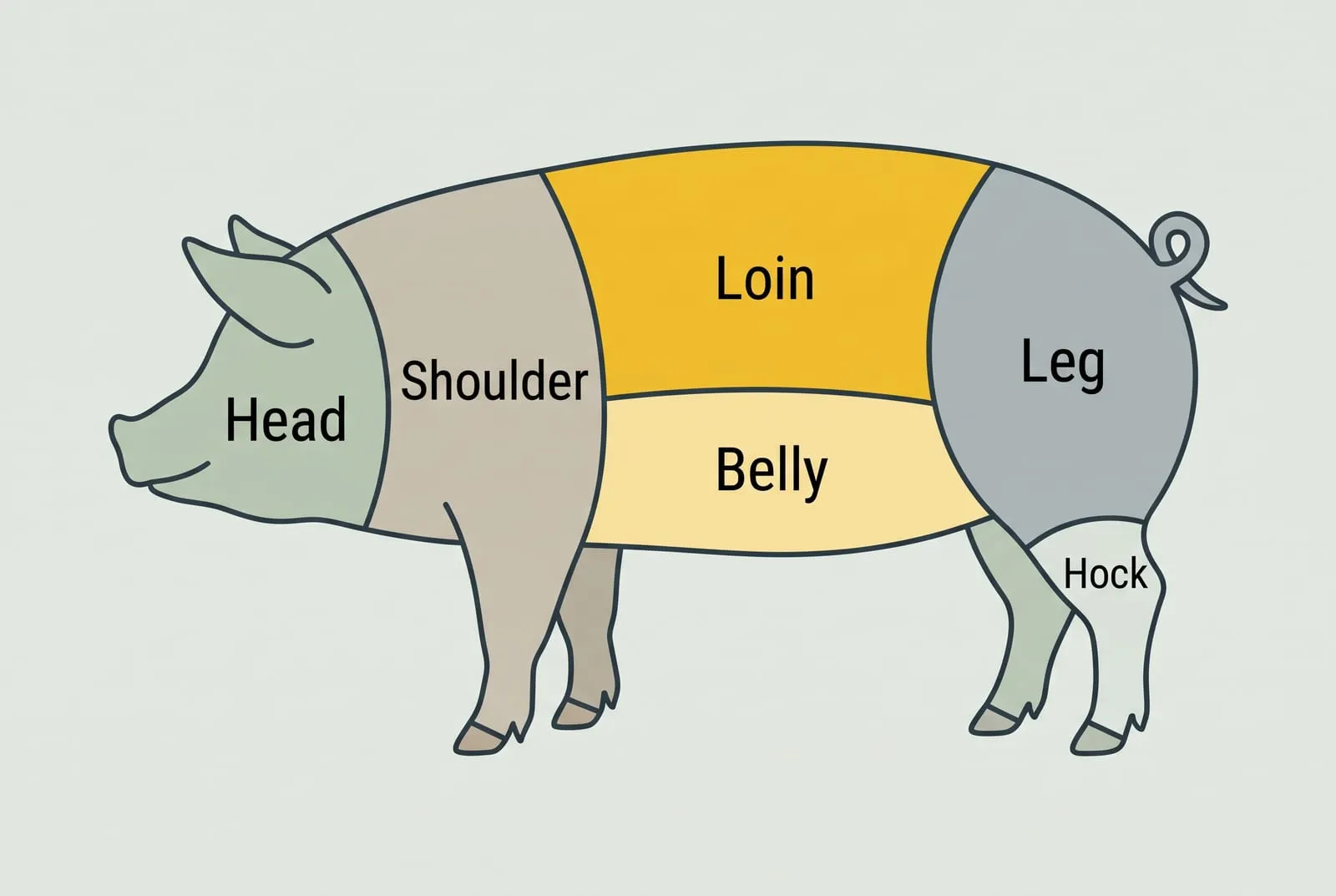
AHDB’s pork cutting guide expects pork to be sold as half a pig. Each half has a shoulder, a loin with the fillet underneath, a belly and a leg.
| Part | Your choices | Example for one half |
|---|---|---|
| Shoulder | Joint on the bone or boned and rolled, collar joint or steaks, dice, mince, sausages | A rolled joint of about 1.5 kg, the rest to sausages |
| Loin | Chops on the bone, boneless steaks, a joint with the rind on for crackling, or back bacon | Half as 2 cm chops, half as a joint |
| Chump | Chops or steaks, or left on the leg | Chump chops |
| Fillet | Whole or as medallions | Whole |
| Belly | A joint, flat or rolled, slices, streaky bacon or spare ribs | Half as slices, half as streaky bacon |
| Leg | Roasting joints, steaks, dice, or cured as gammon | Two gammon joints |
| Extras | Liver, kidneys, heart, head, trotters, flare fat for lard, bones | Liver, kidneys and trotters |
- Each part is cut one way. The loin becomes chops or back bacon, not both, unless you ask for it to be split. With a whole pig, each half can be cut differently.
- Bacon and gammon are cured. Back bacon comes from the loin and streaky from the belly. Gammon is cured hind leg, which needs cooking, while ham is sold ready to eat (Love Pork). Not every abattoir cures, it usually costs extra per kg, and it adds time, so ask before you plan around it.
- Say which ribs you mean. Barbecue spare ribs come off the belly and loin ribs off the loin, so ask for them before those parts are cut. Some butchers use “spare rib” for a shoulder joint or chops instead.
- Keep the rind on any joint you want to roast with crackling, and ask for it scored if you like.
Lamb cutting instructions: a whole lamb
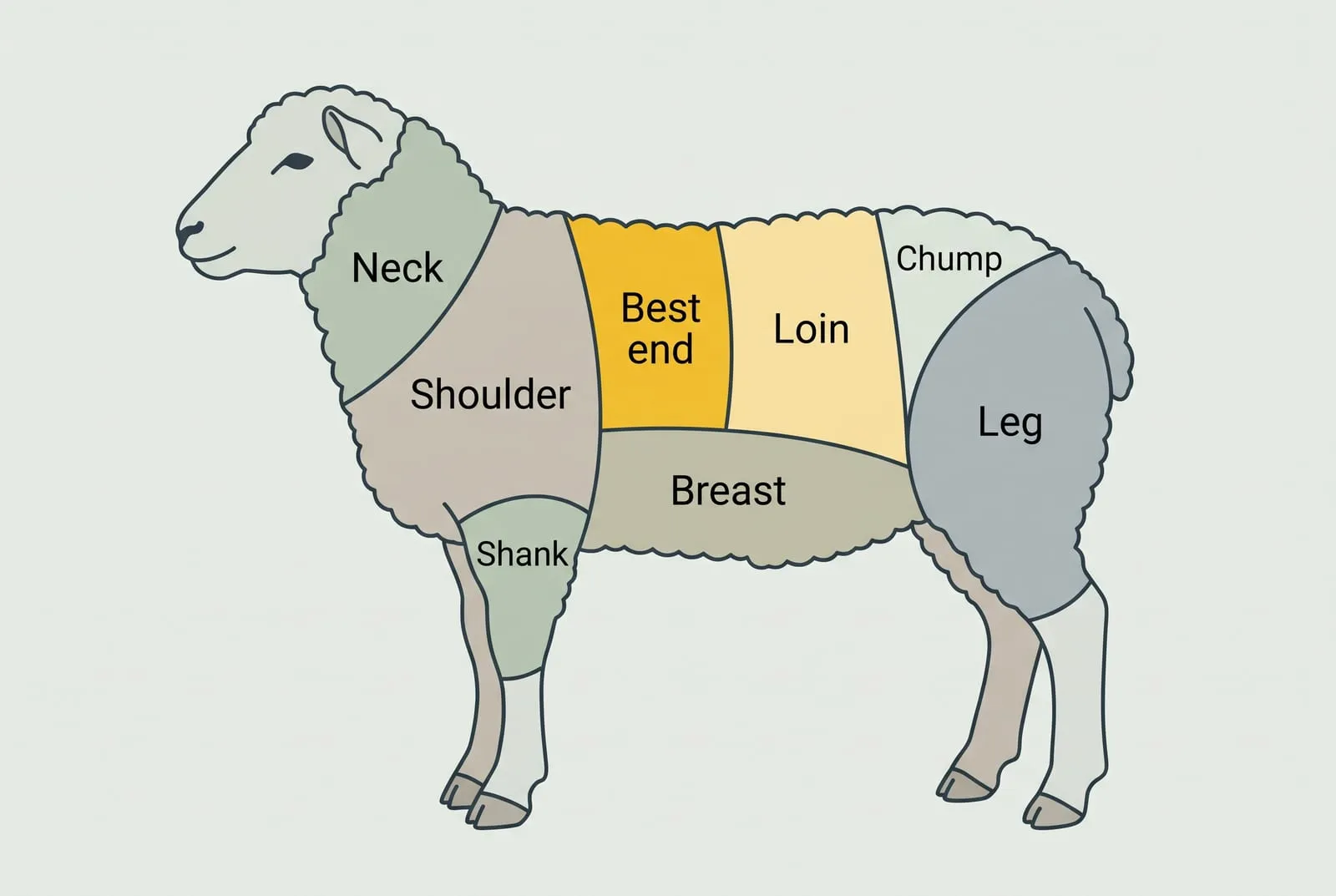
A lamb carcase is small enough to take whole, or to split in half with another household. To give a sense of quantity, AHDB’s specification for a box made from one lamb includes a seven-rib rack, seven cutlets, ten loin chops, a leg roast, two half-leg roasts on the bone, four leg steaks, shoulder roasts, 400 g of diced lamb, four 500 g packs of mince and a neck fillet.
| Part | Your choices | Example order |
|---|---|---|
| Shoulders | Whole on the bone, halved, boned and rolled, diced or minced | One boned and rolled, one cut in half |
| Best ends | A rack, French trimmed or not, or cutlets | One rack, one cut into cutlets |
| Loin | Loin chops, Barnsley (double) chops, or a loin joint | Loin chops, two per pack |
| Chumps | Chump chops, or left on the legs | Chump chops |
| Legs | Whole, halved into fillet and shank ends, boned and butterflied, or steaks | One whole, one halved |
| Neck | Neck fillet, middle neck chops, or scrag for stewing | Neck fillet |
| Breast | Rolled, riblets, or minced | Minced, in 500 g packs |
| Offal | Liver, heart, kidneys | All three |
- Older sheep change the list. Once a sheep or goat is over 12 months old or has a permanent incisor through, its skull and spinal cord are specified risk material (FSA). The head can’t come back, and the carcase is usually split down the backbone to take out the spinal cord, which rules out a whole saddle or Barnsley chops.
- Shanks are the lower legs. Ask for them separately if you want slow-cooked shanks; otherwise they stay on the leg and shoulder joints.
Beef cutting list: a side or a quarter
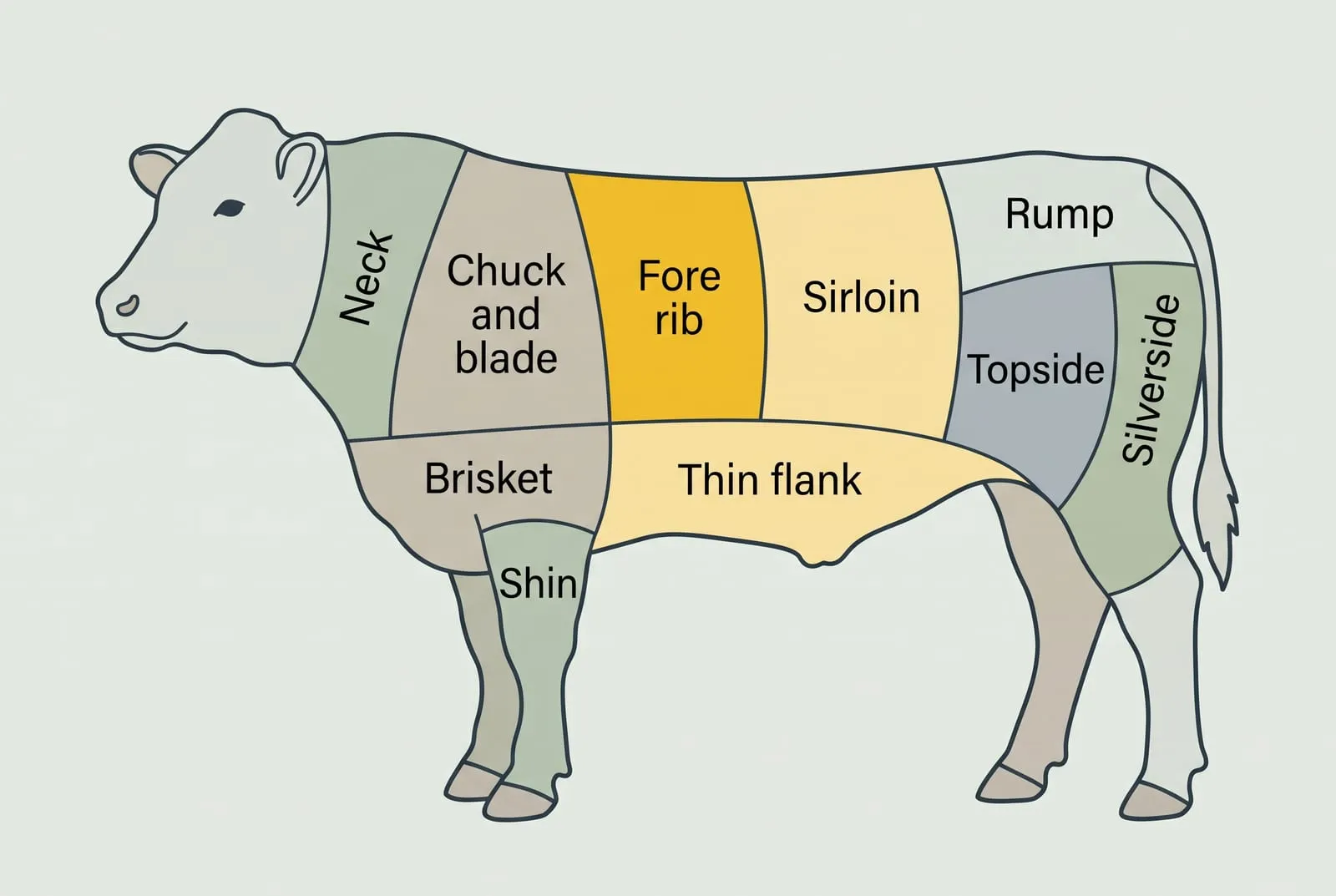
A beef carcase is split into two sides, and each side into a forequarter and a hindquarter. The two hold different cuts: the fore rib, for rib of beef, comes with the forequarter, while the sirloin, with the last three ribs, comes with the hindquarter (AHDB beef cutting guide).
| Quarter | Main cuts | Usual choices |
|---|---|---|
| Hindquarter | Sirloin, fillet, rump, topside, silverside, thick flank (top rump), leg | Steaks from the sirloin, fillet and rump; roasting joints from the topside, silverside and thick flank; the leg for stewing |
| Forequarter | Fore rib, chuck and blade, brisket, clod, neck, shin | Rib of beef on the bone or rib-eye steaks; braising steak from the chuck and blade; brisket rolled or salted; clod, neck and shin for stewing or mince |
- Steaks or joints. The sirloin can be steaks, a roasting joint, or T-bones with the fillet left on. The fillet can stay whole or be cut into steaks.
- T-bones from older cattle. England, Scotland and Wales were recognised as negligible risk for BSE in 2025. Since then, the backbone of cattle over 30 months born and reared in Great Britain is no longer specified risk material (FSA Manual for Official Controls, chapter 2.7), so T-bones and bone-in sirloin from older cattle are possible again. Ask whether your abattoir has changed its procedures.
- Mince and burgers. The flank, clod and other trim make mince. Say how lean you want it, what size packs, and whether some should be burgers or sausages. AHDB’s specification uses mince that is 90% visual lean, in 500 g packs.
- Extras. Ask for the liver, heart, kidneys, tongue, oxtail, suet or marrow bones if you want them. The skull of cattle over 12 months is specified risk material, so the head itself can’t come back.
What a quarter of beef looks like
AHDB’s beef box guide divides a 300 kg carcase into 20 boxes of about 10 to 12 kg. Each box has three roasting joints, three or four packs of steak, three packs of braising steak, a pack of stewing steak, two packs of diced beef and three packs of mince. A quarter of that carcase is five boxes, roughly 50 to 60 kg of meat. Your animal will differ: see how much meat you get from a pig, lamb or cow.
Packing and labelling
- Vacuum packing keeps air off the meat, which helps prevent freezer burn, and the packs stack flat. It often costs extra; plain bags are cheaper.
- Pack sizes: two steaks or chops to a pack, mince in 250 g or 500 g packs, and sausages in the number you’d cook at once.
- Labels: ask for the cut, weight and date on every pack, plus the household’s name if you’re sharing. The FSA advises labelling everything you freeze.
- Freezer time: keep the freezer at around -18°C. The FSA says food won’t go bad in the freezer, but that meat is usually best eaten within two to three months for quality, so order amounts you’ll get through.
- Selling: if you sell any of it, the labels have legal requirements, such as compulsory beef labelling.
Splitting a carcase between households
- Agree the shares before the kill: half a pig or lamb each, or quarters of beef, and whether you’ll split the bill by share or by the weight each household takes home.
- Write one cutting list per share. Each half of a pig can be cut differently, so one household can have loin chops and the other back bacon.
- Ask for mixed quarters of beef. A mixed quarter is half a forequarter and half a hindquarter, so each household gets a fair share of steaks, joints and mince.
- Split a lamb down the middle. Each half gets a leg, a shoulder, a best end and one side of the loin.
- Bag and label each share separately, with the household’s name on every pack.
- Check the selling rules. If friends or neighbours pay you for their share, that can count as selling meat, which brings in food business rules such as registration and labelling. See selling your own meat.
Questions people ask
What cuts do you get from half a pig?
A half pig has a shoulder, half the loin with the fillet, half the belly and a leg. Depending on your cutting list, that becomes joints, chops, steaks, belly slices and sausages, plus bacon or gammon if you have some cured.
How thick should chops and steaks be cut?
About 2 cm is a good starting point for pork and lamb chops. Ask for 2.5 cm or more if you like steaks pink in the middle, and always write the thickness on your cutting list.
What is the difference between a forequarter and a hindquarter of beef?
The hindquarter has most of the steaks and roasting joints, such as sirloin, fillet, rump, topside and silverside. The forequarter has the fore rib and brisket, plus more braising steak, stewing beef and mince.
What is a mixed quarter of beef?
A mixed quarter is a quarter share of a carcase made up of half a forequarter and half a hindquarter. It gives each household a fair mix of steaks, roasting joints, braising cuts and mince.
How do I fill in a cutting sheet?
Work through the carcase part by part, choose joints, chops or steaks for each, and give weights and thicknesses. Then say what goes into mince or sausages, what you want back, and how it should be packed and labelled.
Can you still get T-bone steaks from cattle over 30 months?
Yes, for cattle born and reared in Great Britain. Since Great Britain was recognised as negligible risk for BSE in 2025, the backbone of older cattle is no longer specified risk material, but check that your abattoir has updated its procedures.
Sources
- Food Standards Agency: Manual for Official Controls, chapter 2.7, Specified risk material controls (amendment 113)
- Food Standards Agency: Home slaughter of livestock, a guide to the law in England and Wales (Annex C, SRM by species and age)
- Food Standards Agency: How to chill, freeze and defrost food safely
- Rural Payments Agency: Comply with the Compulsory Beef Labelling Scheme
- AHDB: Pork box, cutting and packaging guidelines (2021)
- AHDB: Beef box, cutting and packaging guidelines
- AHDB: Lamb large box specifications
- AHDB: Box schemes
- Love Pork (AHDB): Gammon and ham
This guide is general information, not legal advice. Rules differ between England and Wales and change over time, so check with your abattoir, vet or local council if you're unsure.