Taking cattle to the abattoir: passports, age and hanging
To take cattle to the abattoir, each animal needs both official ear tags and its passport, which travels with it, and the move must be reported to BCMS within 3 days. In England and Wales, cattle going direct to slaughter don’t need a TB pre-movement test. Since 2025, cattle born and reared in Great Britain no longer need the backbone removed after 30 months.
Passports, ear tags and reporting the move
Not every abattoir takes cattle or does private kill, so start with the abattoirs that take cattle and our guide to booking private kill. Before the day, check each animal has (gov.uk):
- a primary and a secondary official ear tag
- its correct passport, which travels with it
Without these, the abattoir may reject the animal. Cattle that have been refused a passport can’t enter the food chain at all.
Then, as the keeper:
- update your holding register within 36 hours
- report the move off your holding to BCMS within 3 days, for example through CTS Online
The abattoir may report the move for you, but you’re still responsible for making sure it’s done. After slaughter, the abattoir reports the death and sends the passport back to BCMS within 7 days.
The 6-day standstill doesn’t stop a move direct to slaughter, in England or Wales.
Changes coming in 2027
- England: a new cattle tracing service is due to replace the Cattle Tracing System (CTS) in 2027, and CTS carries on until every keeper has moved over. Electronic ear tags are expected for all newborn calves during 2027 (Defra).
- Wales: keepers should register with EIDCymru by 1 February 2027. From 7 June 2027, cattle births, movements and deaths are reported through EIDCymru instead of BCMS. Until then, carry on with BCMS (gov.wales).
TB and moves to slaughter
Cattle going direct to slaughter don’t need a pre-movement TB test, in England or Wales. That includes moves through a collecting centre or a market where every animal goes for slaughter (gov.uk, gov.wales).
If your herd is under TB restrictions:
- England: the general licence APHA sent you when the herd went under restriction covers moves direct to slaughter, so check it before applying for anything else. Licences issued after 30 September 2024 also cover moves through a TB slaughter gathering (red market) (gov.uk). TB Hub notes that cattle moved this way must not be reactors, inconclusive reactors or direct contacts.
- Wales: keepers of restricted herds can apply to APHA for general licence TB16e, which covers moves direct to a slaughterhouse and lasts until the next short-interval test. Call APHA on 0300 303 8268 (gov.wales).
The food chain information for cattle must state your herd’s TB status, and an official vet has to be present when cattle from a restricted herd are killed. Tell the abattoir when you book, and ask whether they take restricted cattle for private kill.
Food chain information and medicines
Every animal sent for slaughter needs food chain information (FCI): a declaration about its health, any medicines it has had and, for cattle, your herd’s TB status. The abattoir will tell you which form to use. If the FCI hasn’t reached the abattoir within 24 hours of the animal arriving, the meat is declared unfit.
Before you sign it:
- check the meat withdrawal period on the label of every medicine you’ve used
- if your vet prescribed a medicine off-label under the cascade, the minimum meat withdrawal is 1.5 times the longest meat withdrawal on the data sheet, 28 days if it isn’t authorised for food-producing animals, or 1 day if its withdrawal is zero (Veterinary Medicines Regulations)
- keep medicine records for at least five years
The form may also ask for a Veterinary Attestation Number (VAN) from an annual vet visit. Without a VAN or membership of a farm assurance scheme, the official vet can’t sign the paperwork that allows meat and by-products to be exported to the EU, so ask the abattoir whether they need one.
Over 30 months: what changed in 2025
On 29 May 2025, England, Scotland and Wales were recognised by the World Organisation for Animal Health as having negligible risk of BSE. As a result, for cattle born, reared and slaughtered in Great Britain, the vertebral column of cattle over 30 months is no longer specified risk material (SRM), and nor are the tonsils, intestines or mesentery (FSA Manual for Official Controls, chapter 2.7).
These are still SRM in cattle over 12 months, and stay at the abattoir:
- the skull, including the brain and eyes but not the lower jaw
- the spinal cord
For private kill beef, this means an older cow or bullock can now be cut like a younger animal, with bone-in sirloin, T-bones and wing rib, once the spinal cord is out. Some older guides and price lists still describe backbone removal for over thirty month (OTM) cattle, so check what your abattoir does now. Cattle from places without negligible-risk status, such as the Isle of Man and Guernsey, still have the full list removed.
Healthy UK-born cattle aren’t BSE tested at slaughter, whatever their age. Testing still applies to at-risk cattle over 48 months, meaning emergency slaughter cases and animals showing signs of illness, injury or poor welfare at the check before slaughter, and to some cattle born abroad. A tested carcase is held until the result is negative (FSA chapter 2.6).
Clean cattle
The FSA grades cattle into five cleanliness categories, from clean and dry to filthy and wet. Only the two cleanest can go to slaughter without further action, and the FSA says it will reject animals that don’t meet the standard (gov.uk).
- Keep cattle dry: wet coats pick up dirt more easily and spread bacteria.
- Bed them well on the farm, in the trailer and at the abattoir.
- Avoid mixing unfamiliar cattle on the journey.
- Treat clipping as a last resort. It stresses the animal, can damage the hide and can injure the person doing it.
Taking cattle in yourself
Anyone moving cattle must make sure they’re fit to travel, plan the journey and keep it short, and give them enough space (gov.uk). If you’re a farmer taking your own cattle less than 50 km from your holding in your own vehicle, only those general rules apply. Over 50 km you need a written journey record, called an animal transport certificate. Over 65 km you also need a type 1 transporter authorisation and a certificate of competence (gov.uk).
An animal isn’t fit to travel if it can’t walk unaided without pain, or has a severe open wound or a prolapse. Nor is a cow in the last 10% of pregnancy, one that has calved in the past week, or a newborn calf whose navel hasn’t healed. If in doubt, ask your vet.
Clean and disinfect the trailer as soon as you reasonably can after unloading, and within 24 hours of the journey ending, using a Defra-approved disinfectant. The rule is the same in England and Wales. Abattoirs normally have a wash-out area.
Bluetongue. As of November 2026 the whole of England and the whole of Wales are bluetongue restricted zones, and you don’t need a specific licence or a pre-movement test to move cattle within either country or between the two (gov.uk, gov.wales). In Wales, animals restricted because of BTV-8 can only go to slaughter under a specific licence. Check the current position before you travel.
Carcase weights
UK average dressed carcase weights for September 2026, from Defra’s slaughter statistics:
| Type | Average carcase |
|---|---|
| Steers | 367.8 kg |
| Heifers | 333.3 kg |
| Young bulls | 374.9 kg |
| Cows and adult bulls | 305.7 kg |
These are national averages, so your animal may weigh more or less. The meat you take home is less than the carcase weight once bone, fat and trim come off: see how much meat you get from a pig, lamb or cow.
Hanging beef
After slaughter the carcase must be chilled to 7°C before it can leave the abattoir. Beef is then usually hung in a chiller before cutting, which makes it more tender and develops the flavour. Hanging takes chiller space, so ask how long the abattoir will hang a beast, whether you can choose, and what it costs. Some charge by the day: the 2026 price list for the University of Bristol’s Langford abattoir, for example, charges £5 a day for cattle from the day after slaughter. Our guide on how long to hang meat covers typical hanging times.
What comes back
- the carcase, split into two sides, or quartered if you ask
- offal: ask what they can return, such as liver, heart, kidneys, tongue and oxtail
- the hide, only if you’ve registered with APHA on form AB117 as a keeper who gets hides back after slaughter (gov.uk), and you’ll need a tanner lined up
The skull and spinal cord of cattle over 12 months stay at the abattoir as SRM.
Halves, quarters and eighths
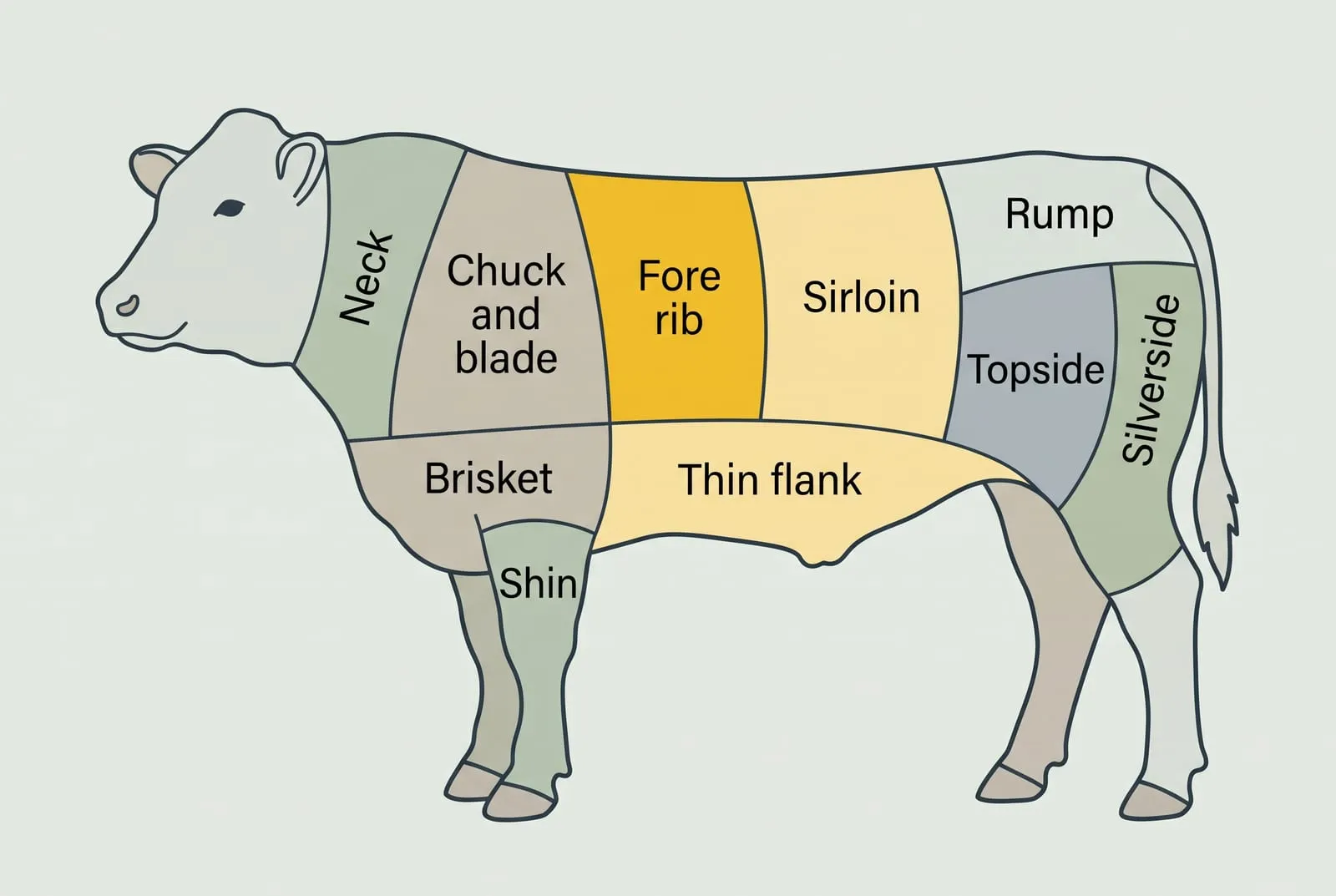
“Half a cow” usually means one side of the carcase. Each side splits into a forequarter and a hindquarter, and they aren’t equal:
- Hindquarter: sirloin, fillet and rump, plus the big roasting joints from the back leg, such as topside and silverside.
- Forequarter: fore rib, brisket, chuck and blade, with more meat for stewing, braising and mince.
So a forequarter and a hindquarter aren’t like-for-like shares. If you’re killing your own beef to split between several households, you can ask the butcher to divide the whole carcase into equal mixed boxes, so each share, whether a quarter or an eighth, gets some of everything. Write it into your cutting list.
Selling shares to other people counts as selling meat. Beef sold to the public needs compulsory beef labelling, and you’ll need to register as a food business: see selling your own meat.
Questions people ask
Do cattle need a passport to go to the abattoir?
Yes. Each animal needs its passport and both official ear tags, or the abattoir may turn it away. After slaughter the abattoir sends the passport back to BCMS.
Do cattle going direct to slaughter need a TB test?
No. In England and Wales, cattle moving direct to slaughter, including through a collecting centre or a slaughter-only market, are exempt from pre-movement TB testing.
Can I send cattle to slaughter if my herd is under TB restrictions?
Usually, under licence. In England the general licence APHA sent when your herd went under restriction covers moves direct to slaughter, and in Wales you can apply to APHA for general licence TB16e. Tell the abattoir, because an official vet has to be present.
Do you still have to remove the backbone from cattle over 30 months?
Not for cattle born and reared in Great Britain. Since England, Scotland and Wales were recognised as negligible BSE risk in 2025, the vertebral column is no longer specified risk material, though the skull and spinal cord of cattle over 12 months still are.
Are cattle over 30 months tested for BSE?
Healthy UK-born cattle are not BSE tested at slaughter, whatever their age. Testing still applies to at-risk cattle over 48 months, such as emergency slaughter cases, and to some cattle born abroad.
How much does half a cow weigh?
Half a cow usually means one side of the carcase. The average UK steer carcase in September 2026 was 367.8 kg, so a side was around 184 kg before boning, and the meat you take home is less.
Sources
- GOV.UK: Send cattle to slaughter
- GOV.UK: Report and record the deaths of cattle at slaughter
- Defra: Livestock Information Transformation Programme (LITP)
- Welsh Government: Planned move from BCMS to EIDCymru
- Disease Control (England) Order 2003, Schedule 1: movements permitted during the standstill period
- Welsh Government: 6 day standstill rule
- GOV.UK: Cattle movements: exemptions from pre-movement or post-movement bovine TB testing
- Welsh Government: Bovine TB pre-movement and post-movement testing
- GOV.UK: Move animals under disease controls
- Welsh Government: Bovine TB: moving cattle from premises under TB restriction (general licence TB16e)
- TB Hub: Licensing of TB restricted cattle in England
- Food Standards Agency: Manual for Official Controls, chapter 2.7, specified risk material
- Food Standards Agency: Manual for Official Controls, chapter 2.6, TSE testing
- Food Standards Agency: Manual for Official Controls (chapters 2.1, 2.2 and 2.11)
- Regulation (EC) No 853/2004, Annex II Section III: food chain information
- Veterinary Medicines Regulations 2013, Schedule 4: cascade withdrawal periods
- GOV.UK: Record keeping requirements for veterinary medicines
- Regulation (EC) No 999/2001, Annex V: specified risk material
- GOV.UK: UK international risk status for BSE downgraded in huge boost to farm sector
- GOV.UK: Cleaner cattle and sheep
- GOV.UK: Animal welfare in transport
- GOV.UK: Transporting animals in Great Britain
- Regulation (EC) No 1/2005, Annex I Chapter I: fitness for transport
- Transport of Animals (Cleansing and Disinfection) (England) (No. 3) Order 2003, article 3
- Isle of Anglesey County Council: cleansing and disinfection of vehicles in Wales
- GOV.UK: Bluetongue: latest situation
- Welsh Government: Bluetongue virus current restrictions
- GOV.UK: Animal by-product categories, site approval, hygiene and disposal
- GOV.UK: Comply with the compulsory beef labelling scheme
- Defra: Cattle, sheep and pig slaughter statistics, data to September 2026
- University of Bristol, Langford Abattoir: price list 2026
This guide is general information, not legal advice. Rules differ between England and Wales and change over time, so check with your abattoir, vet or local council if you're unsure.