Taking pigs to the abattoir: paperwork, weights and timing
To take pigs to the abattoir in England or Wales, book a kill date, mark each pig with your herd mark using an ear tag, tattoo or slap marks, and set up the move on eAML2 before the pigs leave. The eAML2 licence carries the food chain information. Stop feed 8 to 12 hours before slaughter, but not water, and clean the trailer within 24 hours.
Pig slaughter weights and ages
Porker, cutter and baconer are trade names for pigs grown to different weights. The figures below are typical, and they vary with breed and feeding.
| Type | Liveweight | Typical age | Grown for |
|---|---|---|---|
| Porker | About 60 kg | 4 to 6 months | Fresh pork |
| Cutter | Between porker and baconer | In between | Larger joints |
| Baconer | 80 to 100 kg | About 8 to 10 months | Bacon and ham |
Figures from the Accidental Smallholder pig glossary.
Commercial pigs are taken heavier. The UK average clean pig carcase was 91.2 kg deadweight in September 2026, according to Defra’s slaughter statistics.
Liveweight is the pig on the scales. Deadweight is the carcase after slaughter and dressing. AHDB puts the killing-out percentage for pigs at 72 to 80%, with a UK average of 75 to 76% (AHDB factsheet), so a 60 kg porker gives a carcase of roughly 45 kg. The meat you take home is less again once bone and trim come off: see how much meat you get from a pig, lamb or cow.
Weigh pigs with a weigh tape or scales as the date gets close. Some abattoirs charge more for heavier pigs, so ask how they price and whether there’s a size they can’t take.
Booking the kill
Not every abattoir takes pigs or does private kill. Look through the abattoirs that take pigs and phone before you settle on a date. Book well ahead for autumn: some abattoirs stop private kills in late autumn because of the pre-Christmas rush.
When you book, ask:
- which days they kill pigs, and what time to arrive
- whether they scald or skin pigs
- whether they hang, cut and cure, or you need your own butcher
- what the price includes, such as the Trichinella test
- when you can collect
Our guide to booking private kill has a fuller checklist.
The pig movement licence (eAML2)
In England and Wales every pig move, including a move to the abattoir, must be recorded on eAML2 before the pigs leave the holding. eAML2 is the electronic movement licence, and for moves to slaughter it also carries the food chain information.
- Set up the move before the day. Choose the “to an abattoir” option and select the abattoir. Welsh guidance says moves can be set up as much as a year ahead.
- No computer? Phone the eAML2 bureau on 0844 335 8400, Monday to Friday, 9am to 5pm. Allow time for the movement document to reach you by post or email, because the pigs can’t move until you have it.
- Send a copy of the movement document, called the haulier summary, with the pigs. Printing it is the safe option.
- On the day, confirm how many pigs you loaded, online, through the bureau or by text (register your phone in the Pig Hub section of eAML2 first). In England you must do this within 24 hours of the pigs leaving.
- The abattoir confirms that the pigs arrived.
The gov.uk guidance on reporting pig movements covers England, and the Welsh Government pig guidance covers Wales.
The standstill rules (20 days after pigs come onto your holding, 6 days after cattle, sheep or goats) don’t apply to a move direct to slaughter.
Ear tags, tattoos and slap marks
Before they leave, every pig must carry your herd mark in one of these ways (gov.uk):
- an ear tag in either ear
- a tattoo on either ear
- slap marks: a tattoo on the front of both shoulders, put on with a slapper
Ear tags show “UK” followed by your herd mark. In England, ear tattoos must start with “UK” too.
Points that catch people out:
- It must be your herd mark, for the holding the pigs are leaving. In England that applies even if a pig already carries its breeder’s tag or tattoo. Welsh guidance says the same for pigs over a year old.
- Tags must be heat resistant, so they survive processing. Accidental Smallholder warns that tags can take several weeks to arrive, so order early.
- Paint marks don’t count. A temporary paint mark is only allowed for young pigs moving from farm to farm, never to the abattoir.
- No individual number is needed for pigs going to slaughter.
An animal whose identity can’t be established is declared unfit for human consumption, and it can’t go home either. Check every pig before you load.
Food chain information and medicines
Food chain information (FCI) tells the abattoir and the official vet about your pigs’ health, any medicines they’ve had and how they were housed. On eAML2 it’s part of the movement licence. If the abattoir doesn’t receive FCI within 24 hours of the pigs arriving, the meat is declared unfit.
Before you declare that withdrawal periods have been met:
- check the meat withdrawal period on the label of anything you’ve used, or in the NOAH compendium
- if your vet prescribed a medicine off-label under the “cascade”, the minimum meat withdrawal is 1.5 times the longest meat withdrawal on the product’s data sheet, 28 days if it isn’t authorised for food-producing animals, or 1 day if its withdrawal is zero (Veterinary Medicines Regulations)
- keep your medicine records for at least five years
Pigs that break a withdrawal period are killed separately and their meat is declared unfit.
Unless your holding is officially recognised as having controlled housing, your pigs will be tested for the Trichinella parasite. No part of the carcase containing muscle can leave the abattoir until the result is negative (FSA Manual for Official Controls), so ask whether the test is in the price.
Feeding and fasting before the journey
AHDB gives the optimal fasting period before slaughter as 8 to 12 hours, counting loading, the journey and any wait at the abattoir. Feed still in the gut adds nothing to the carcase, but fasting for too long stresses pigs and costs weight: pigs fasted for 24 hours lost 3.8% of their liveweight and 2.1% of carcase weight compared with a 4-hour fast.
Work back from when your pigs are likely to be killed, which the abattoir can tell you. Don’t take water away: in England the welfare regulations require pigs over two weeks old to have continuous access to fresh drinking water. If pigs wait at the abattoir for more than 12 hours, they must be fed there, and they must have water at all times.
Taking pigs in yourself
Whoever moves the pigs must make sure they’re fit to travel, plan the journey and keep it short, give them enough floor space and headroom, and avoid causing injury or unnecessary suffering (gov.uk). On top of that:
| Journey | Extra paperwork |
|---|---|
| Your own pigs, in your own vehicle, under 50 km from your holding | None beyond the movement licence |
| 50 to 65 km | A written journey record (animal transport certificate) |
| Over 65 km | Also a type 1 transporter authorisation and a certificate of competence |
The animal transport certificate records the animals’ origin and owner, where and when you set off, the destination and the expected journey time. Gov.uk has a template on its transporting animals page.
A pig isn’t fit to travel if it can’t walk unaided without pain, has a severe open wound or a prolapse, is a sow in the last 10% of pregnancy, or has farrowed in the past week. If in doubt, ask your vet.
Clean and disinfect the trailer as soon as you reasonably can after unloading, and within 24 hours of the journey ending. Remove the muck and bedding, wash it down, including the wheels, mudguards and wheel arches, then use a Defra-approved disinfectant at the general orders dilution. Never load animals into a dirty trailer. Abattoirs normally have a wash-out area. In England, if you leave without washing out, you have to sign a declaration saying where the trailer will be cleaned. Wales has the same 24-hour rule.
At the abattoir
Arrive at the time you’re given. An official vet or inspector checks the pigs before slaughter. Once a pig has been delivered to an abattoir it can’t go back home, so make your decision before you load.
After slaughter the carcase must be chilled to 7°C, and the offal to 3°C, before it leaves the abattoir. If your pigs are tested for Trichinella you also wait for the result, so you can’t take a warm carcase home on the day.
What comes back
Pigs aren’t covered by the specified risk material rules, which apply to cattle, sheep and goats, so on a pig private kill the head and offal can come back if the abattoir agrees. Ask for what you want:
- the carcase, whole or in sides
- the head and trotters
- liver, heart and kidneys, and caul fat if they save it
- blood for black pudding, if they can collect it
Ask too whether the pig will be scalded or skinned:
- Scalded: the carcase goes into hot water and the hair is scraped off. The skin stays on, which you need for crackling and rind-on bacon and ham.
- Skinned: the skin comes off with the hair. Accidental Smallholder notes that some abattoirs choose to skin rather than try to remove the hair, so if you want the skin on, check before you book.
Hanging, cutting and curing
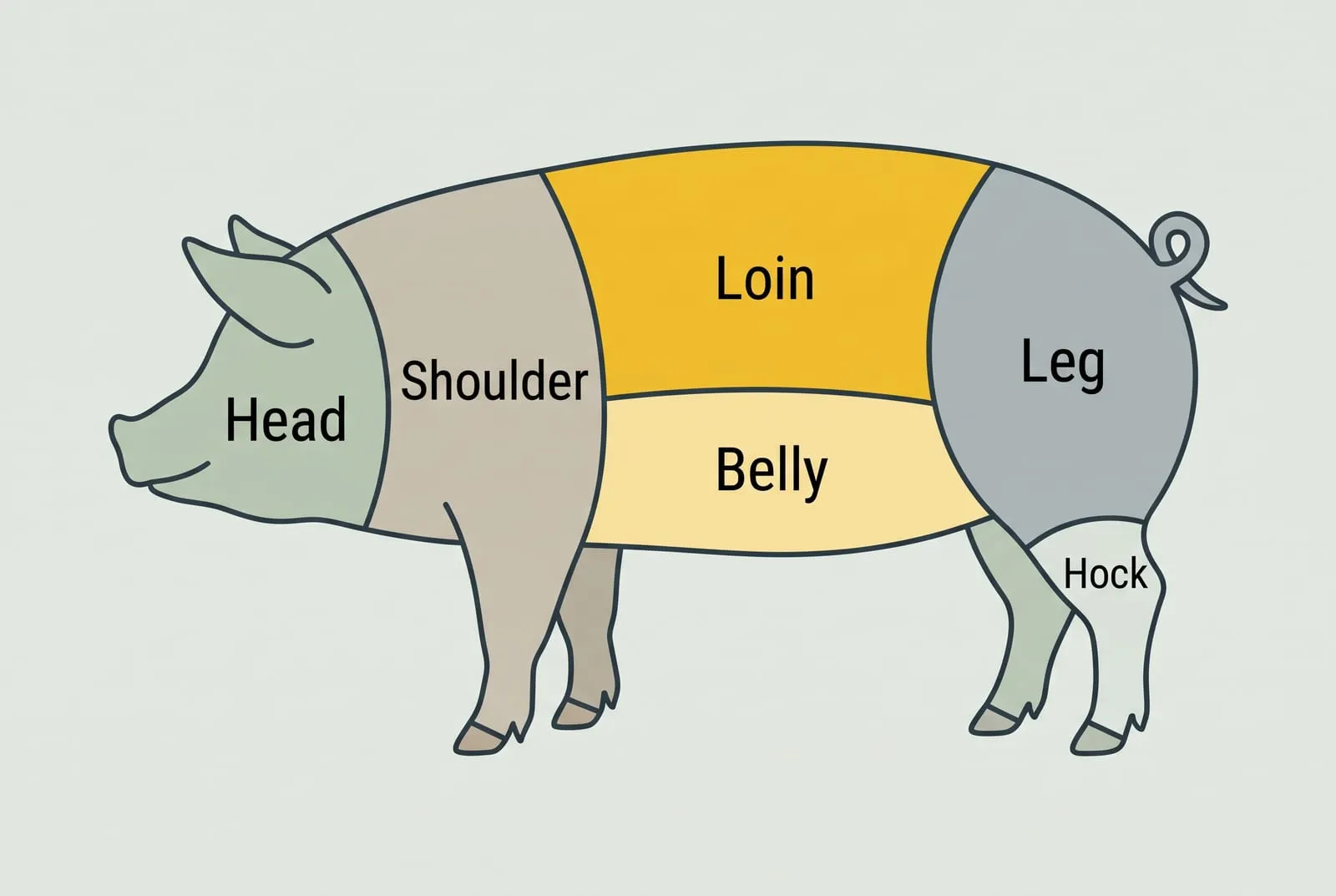
Ask whether the carcase is hung before cutting and for how long. Our guide on how long to hang meat explains what hanging does.
Give the butcher a cutting list: joints or chops, belly whole or sliced, how much goes into sausages and, for a baconer, which parts go for bacon and which for ham.
Some abattoirs and butchers cure bacon and ham and make sausages. Others will cut the pig so you can cure it at home. If you plan to sell any of the meat, you must register as a food business with your council at least 28 days before you start: see selling your own meat.
Questions people ask
What weight should a pig be for slaughter?
Porkers are usually killed at about 60 kg liveweight and baconers at 80 to 100 kg liveweight. Commercial pigs go heavier: the UK average clean pig carcase was 91.2 kg deadweight in September 2026.
How old are pigs when they are slaughtered?
Porkers are usually ready at four to six months old and baconers at about eight to ten months, depending on breed and feeding.
Do I need a movement licence to take pigs to the abattoir?
Yes. In England and Wales every pig move, including to slaughter, must be set up on eAML2 before the pigs leave, online or by phoning the eAML2 bureau on 0844 335 8400. A copy of the movement document travels with the pigs.
Do pigs need ear tags to go to slaughter?
They need your herd mark on a heat-resistant ear tag, an ear tattoo, or slap marks on both front shoulders. A temporary paint mark is not allowed for a move to the abattoir.
How long should pigs be off feed before slaughter?
AHDB gives the best fasting period as 8 to 12 hours before slaughter, counting loading, the journey and any wait at the abattoir. Keep water available until the pigs are loaded.
Can I have my pig back with the skin on for crackling?
Only if the abattoir scalds pigs and scrapes off the hair. Some abattoirs skin pigs instead, which takes the rind off, so ask before you book.
Sources
- GOV.UK: Pig keepers: report and record movements to or from your holding
- GOV.UK: Pig keepers: identify animals before moving them
- GOV.UK: Moving pigs: what keepers need to know
- Welsh Government: Pig keeper guidance on identification and movement
- eAML2: electronic pig movement licensing for England and Wales
- Food Standards Agency: Manual for Official Controls (chapters 2.1, 2.2, 2.4 and 2.11)
- Regulation (EC) No 853/2004, Annex II Section III: food chain information
- Veterinary Medicines Regulations 2013, Schedule 4: cascade withdrawal periods
- GOV.UK: Record keeping requirements for veterinary medicines
- Welfare of Farmed Animals (England) Regulations 2007, Schedule 8: pigs
- Regulation (EC) No 1099/2009, Annex III: lairage rules
- GOV.UK: Animal welfare in transport
- GOV.UK: Transporting animals in Great Britain
- Regulation (EC) No 1/2005, Article 1: farmers moving their own animals under 50 km
- Regulation (EC) No 1/2005, Article 6: journeys up to 65 km
- Regulation (EC) No 1/2005, Annex I Chapter I: fitness for transport
- Transport of Animals (Cleansing and Disinfection) (England) (No. 3) Order 2003, article 3
- Transport of Animals (Cleansing and Disinfection) (England) (No. 3) Order 2003, article 8
- Isle of Anglesey County Council: cleansing and disinfection of vehicles in Wales
- GOV.UK: Defra-approved disinfectant: when and how to use it
- Disease Control (England) Order 2003, article 10: movements to and from slaughterhouses
- Regulation (EC) No 999/2001, Annex V: specified risk material
- GOV.UK: Register a food business
- Defra: Cattle, sheep and pig slaughter statistics, data to September 2026
- AHDB Factsheet 7: Factors affecting killing-out percentage in pigs
- Accidental Smallholder: Pig terminology
- Accidental Smallholder: Preparing pigs for slaughter
This guide is general information, not legal advice. Rules differ between England and Wales and change over time, so check with your abattoir, vet or local council if you're unsure.