Warm wood pigeon salad with bacon, beetroot and hazelnuts
Wood pigeon breasts pan-fried until cooked through, sliced thin over watercress with crisp bacon, beetroot and toasted hazelnuts, with a warm dressing made in the pan.
- Serves 2
- Prep 20 min
- Cook 25 min
- Total 45 min
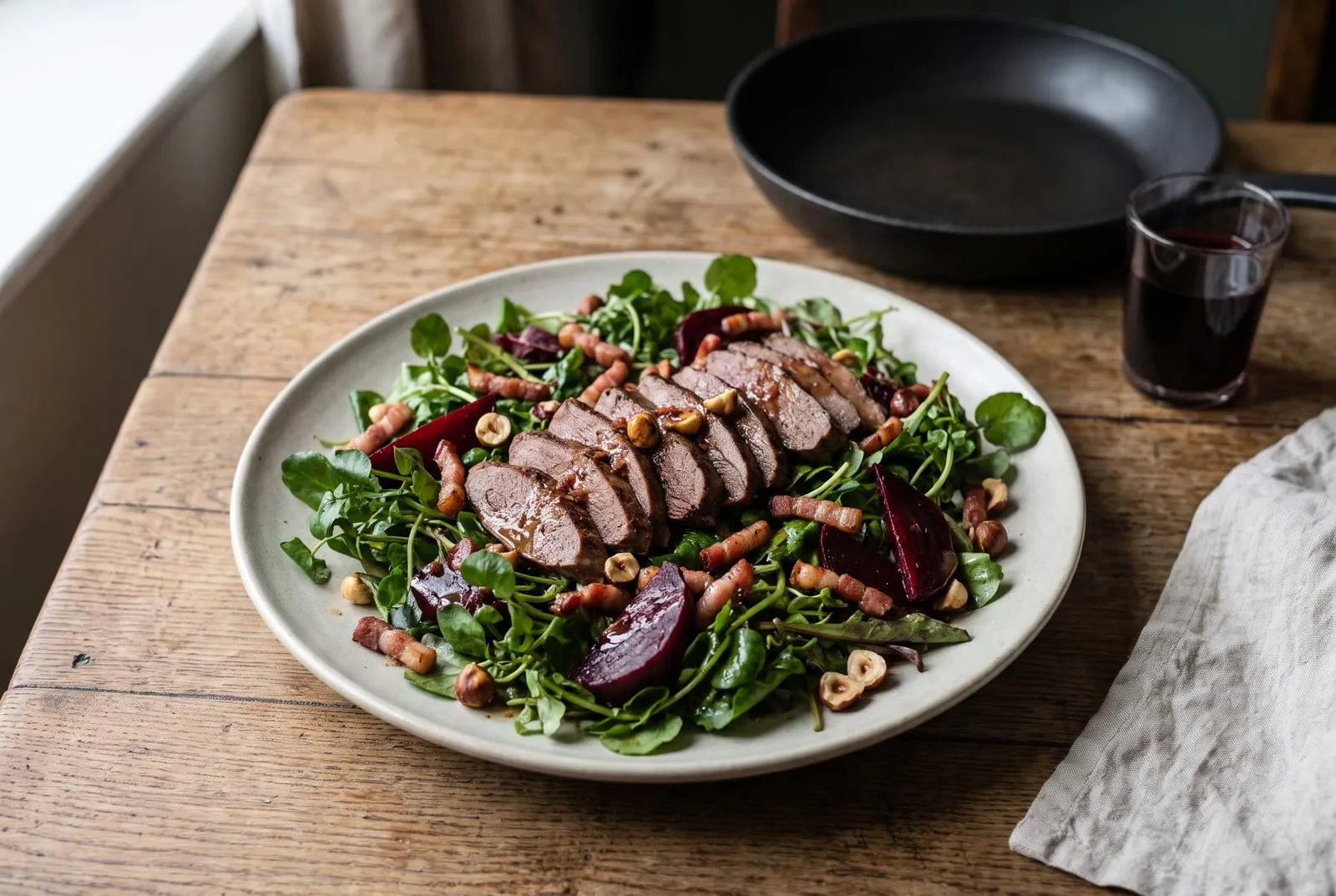
Pan-fry wood pigeon breasts for 2 minutes a side in a hot pan, then take the middle to 70°C and hold it there for 2 minutes. That cooks them all the way through, as the FSA advises for game birds, and a probe, a short rest and thin slicing keep them moist. Wood pigeon is shot and sold all year, so the salad suits any month.
Breasting a wood pigeon
Breasting a pigeon is the same quick job as breasting a pheasant, so follow the breasting steps in our pan-fried pheasant breasts recipe, including its advice on hygiene and finding shot. The difference is size. One online game supplier lists pigeon breast fillets at 40 to 50g each, so two birds give the four breasts this recipe uses. Skin them, and keep the legs and carcasses for stock.
Freshness
Unlike other game birds, pigeon isn’t hung. The Countryside Alliance’s Game to Eat campaign says it should be eaten straight away, where it suggests 5 to 7 days at about 5°C for other game birds. Our guide to how long to hang meat has the detail.
If you shoot your own, the Code of Good Shooting Practice says to carry birds in open game carriers rather than closed bags, lay them on their backs with space between them, and never leave them in heaps. If you buy them, Great British Chefs advises choosing young birds, which have paler, more tender meat, and avoiding any with bruised or torn flesh.
At home, the FSA says to keep raw poultry in its packaging or a sealed container on the bottom shelf of a fridge set between 0 and 5°C, and to defrost frozen breasts fully in the fridge and use them within 24 hours.
Is wood pigeon game?
Not in law. The Game Act 1831 counts hares, pheasants, partridges, grouse, heath or moor game and black game as game, and wood pigeon isn’t among them. Nor does it have an open season: it isn’t in Schedule 2 to the Wildlife and Countryside Act 1981, the list of birds that may be killed or taken outside their close seasons. It’s controlled instead by general licences, which let the owner or occupier of the land, and anyone they authorise, shoot it all year to prevent serious damage, for example to crops. The licences aren’t for shooting purely for the pot.
The 2026 licences are GL42 in England, from Natural England, General Licence 001 in Wales, from Natural Resources Wales, and GL02/2026 in Scotland, from NatureScot. Each runs to 31 December 2026, so look up the current one. The conditions differ: England’s says you must make reasonable attempts at other lawful methods first, unless they would be impractical, ineffective or disproportionate, where Wales’s says you should.
Wood pigeon can be sold dead at any time of year. It’s the only bird in Part II of Schedule 3 to the Act, the birds that may be sold dead at all times, and that Part covers England, Wales and Scotland. Food hygiene rules still apply. The FSA’s wild game guidance counts wild birds hunted for human consumption as wild game, so in England and Wales you must register as a food business with your council before you pluck or breast birds for sale. Our guide to deer and wild game processing explains the rules; Food Standards Scotland has its own wild game guidance.
The law may change. In March 2026 the UK, Scottish and Welsh governments consulted on adding woodpigeon to Schedule 2, so a close season could be set for its breeding period. The consultation closed on 17 May 2026 and, when we checked on 5 November 2026, no outcome had been published.
Where to buy wood pigeon
Try a game dealer, a butcher or an online game supplier, many of which sell breasts in frozen packs. The supplier above sells fillets in packs of 4 and 10, and a 1kg bag, says its pigeon is available all year, and offers a choice of lead or steel shot. Our wild game listings show the approved game handlers near you.
Shot and lead
The FSA lists wood pigeon as lead-shot game. It says people who eat lead-shot game often, especially small game, should cut down, because lead can harm the developing brain and nervous system. That matters most for toddlers, children, pregnant women and women trying for a baby. Its cooking advice says to avoid game birds altogether during pregnancy, because the meat may contain lead shot. This covers England, Wales and Northern Ireland, and Food Standards Scotland gives the same advice.
Ask your supplier whether the pigeon was shot with lead. Steel shot is the alternative, and the supplier above warns that it’s harder than lead, so bite carefully either way. If you prepare birds yourself, the FSA’s wild game guidance says to remove as much lead as possible, with the surrounding meat. Our pheasant recipe explains how to find pellets. Under regulations made in March 2026, lead shot can’t be used or sold in England, Wales and Scotland after 1 April 2029, apart from a few narrow exceptions.
Cooking it through without drying it out
Plenty of recipes serve pigeon breast pink, and Great British Chefs aims for a pink middle. This one doesn’t. The FSA counts game birds as poultry, with chicken, turkey and duck, which can have bacteria all the way through the meat. It says they must be cooked all the way through: no pink meat, juices that run clear, and the middle at 70°C for 2 minutes, or an equivalent such as 75°C for 30 seconds. The same page says properly cooked game birds are safe to eat, and bird flu is a very low food safety risk. In Scotland, Food Standards Scotland advises 75°C in the thickest part, for poultry and game such as partridge and pheasant.
Pigeon breast is lean, so the recipe keeps it moist by technique, not by leaving it pink:
- A hot pan. The breasts brown in 2 minutes a side, in bacon fat and oil, before the middle overcooks.
- A probe. Push it into the thick end of the biggest breast, along the middle, and clean it after each use, as the FSA advises. With breasts this small, a minute either way is the difference between juicy and dry, so stop as soon as the middle has held 70°C for 2 minutes.
- A short rest. A few minutes on a clean, warm plate, not the board that held the raw meat.
- Thin slices and a warm dressing. The butter and the dressing replace the fat the meat lacks.
Using the rest of the bird
The legs have little meat, but the carcasses make a dark, strong stock. Pick out any shot you can find, then simmer them with an onion, a carrot, a celery stick and a bay leaf for about 2 hours and strain. The FSA says to get cooked food into the fridge within 1 to 2 hours, in small portions so it cools quickly, and to eat it within 48 hours or freeze it. Double-bag the feathers and trimmings for the bin, one of the options in the FSA’s wild game guidance for game waste.
Leftovers
The FSA says leftovers can be eaten cold if they were cooked properly, cooled and put in the fridge within 2 hours, and should be eaten within 48 hours or frozen. Cold pigeon is better than reheated, which risks drying it out: slice it into a sandwich or a lentil salad. Keep dressed leaves separate, as they won’t keep. If you do reheat anything, do it only once, until steaming hot all the way through.
Serving through the year
Wood pigeon is available all year, so the salad can follow the seasons. Great British Chefs pairs the meat with autumn flavours such as beetroot, butternut squash and mushrooms. In winter, swap the beetroot for blood orange segments and red chicory. In spring, use pea shoots and new potatoes. In summer, use fresh redcurrants in place of the jelly, and rocket for the watercress.
Warm wood pigeon salad with bacon, beetroot and hazelnuts
- Serves 2
- Prep 20 min
- Cook 25 min
- Total 45 min
Ingredients
- 4 wood pigeon breasts (from 2 birds), skinned
- Salt and freshly ground black pepper
- 1 tbsp rapeseed oil
- 15g butter
- 2 sprigs of thyme
For the salad
- 100g smoked streaky bacon lardons
- 2 cooked beetroot (about 200g, not in vinegar), cut into wedges
- 30g shelled hazelnuts
- 80g watercress and other bitter leaves, such as red chicory or radicchio
For the warm dressing
- 1 small shallot, finely chopped
- 2 tbsp sherry vinegar
- 1 tbsp redcurrant jelly
- 1 tsp Dijon mustard
- 1 tbsp olive oil
Method
- If you're starting with whole birds, take the breasts off first, as described above. Feel each breast over for shot, check for feathers, and cut away any bloodshot or damaged meat. Pat the breasts dry with kitchen paper and season both sides with salt and pepper. Toast the hazelnuts in a dry frying pan over a medium heat for 3 to 4 minutes, shaking the pan, until golden. Tip them out, let them cool for a minute and halve them.
- Put the lardons in the same pan over a medium heat and fry them for 6 to 8 minutes, stirring now and then, until crisp and golden. Lift them out with a slotted spoon onto kitchen paper, then pour off all but 1 tbsp of the fat.
- Turn the heat up to medium-high and add the oil. When it shimmers, lay the breasts in with space between them. Leave them alone for 2 minutes, until the underside is deep brown, then turn them over.
- Turn the heat down to medium, add the butter and thyme, and spoon the foaming butter over the breasts for about 2 minutes. Push a probe thermometer into the thick end of the biggest breast, along the middle. When it reads 70°C, turn the heat to low and keep basting for 2 minutes more, so the middle holds 70°C for 2 minutes, the FSA's test for food that's fully cooked. If it isn't at 70°C yet, keep basting and check again after a minute. In Scotland, Food Standards Scotland advises 75°C, so take the middle to 75°C instead. Without a probe, cut into the thickest part: there should be no pink meat, and the juices should run clear.
- Lift the breasts onto a clean, warm plate, not the board they were prepared on. Cover loosely with foil and leave to rest for 3 to 4 minutes while you make the dressing.
- Leave about 1 tbsp of fat in the pan and put it over a medium heat. Fry the shallot for 1 minute, until soft. Pour in the vinegar, which will hiss, then stir in the redcurrant jelly and mustard until the jelly melts. Let it bubble for 1 minute, scraping up the browned bits and taking out the thyme stalks, then take the pan off the heat. Whisk in the olive oil and any juices from the resting plate, and season to taste.
- Toss the watercress and other leaves with the beetroot and half the dressing in a large bowl, and divide between two plates. Slice each breast thinly across the grain and lay the slices on top. Scatter over the lardons and hazelnuts, spoon the rest of the warm dressing over the pigeon and serve straight away.
What you'll need
- Poultry shears Snips through wing and leg joints, and halves small birds.
- Fish-bone tweezers Pulls out stray feathers, shot and pheasant leg tendons.
- Heavy frying pan Cast iron or thick steel stays hot when cold meat goes in, so it browns rather than stews.
- Thin-tip probe thermometer A slim probe reads the middle of a small breast or leg without touching bone.
- Colour-coded chopping boards Keeps a board just for raw meat, as the FSA advises.
These are Amazon links. If you buy through them, Lairage may earn a small commission at no extra cost to you.
Questions people ask
Can you eat wood pigeon pink?
Many recipes serve it pink, but the FSA's advice is not to. It counts game birds as poultry, like chicken, turkey and duck, which can have bacteria all the way through the meat, so they need cooking all the way through. That means no pink meat, juices that run clear, and 70°C in the middle for 2 minutes, or an equivalent such as 75°C for 30 seconds. In Scotland, Food Standards Scotland advises 75°C.
How long do you cook wood pigeon breasts?
About 8 minutes in the pan for small skinned breasts: 2 minutes a side to brown, a minute or two of basting on a lower heat, then 2 minutes more with the middle at 70°C. Rest them for 3 to 4 minutes before slicing. Go by a probe thermometer rather than the clock, because breast size varies.
Do you need to hang wood pigeon?
No. The Countryside Alliance's Game to Eat campaign says pigeon should be eaten straight away, whereas it suggests 5 to 7 days at about 5°C for other game birds. Keep pigeon cool from the moment it's shot, and cook it by its use-by date or freeze it.
Can you sell wood pigeon?
Yes, dead and at any time of year. Wood pigeon is the only bird in Part II of Schedule 3 to the Wildlife and Countryside Act 1981, the birds that may be sold dead at all times, in England, Wales and Scotland. Food hygiene rules still apply: in England and Wales you must register as a food business with your council before you pluck or breast birds for sale.
Does wood pigeon contain lead shot?
It can. The FSA lists wood pigeon as lead-shot game and says people who eat it often, especially small game, should cut down, particularly toddlers, children, pregnant women and women trying for a baby. It also says to avoid game birds in pregnancy. Ask your supplier whether the birds were shot with lead, and feel the meat for pellets as you prepare it.
Sources
- Food Standards Agency: Cooking your food
- Food Standards Agency: Eating lead-shot game
- Food Standards Agency: How to chill, freeze and defrost food safely
- Food Standards Agency: The Wild Game Guidance
- Food Standards Scotland: Turkey cooking guide, which covers game such as partridge and pheasant
- Food Standards Scotland: Lead-shot game
- Food Standards Scotland: Wild game
- Wildlife and Countryside Act 1981, Schedule 2: birds which may be killed or taken
- Wildlife and Countryside Act 1981, Schedule 3: birds which may be sold
- Game Act 1831, section 2: what shall be deemed game
- Natural England: GL42, general licence to kill or take certain species of wild birds to prevent serious damage (2026)
- Natural Resources Wales: General Licence 001 (2026), to prevent serious damage or spread of disease
- NatureScot: General licence GL02/2026, to prevent serious damage to livestock, foodstuffs for livestock, crops, vegetables and fruit
- Defra: Improving protection for huntable wild birds (consultation, 23 March to 17 May 2026)
- Defra: Stronger protections to help protect threatened wild birds (23 March 2026)
- Countryside Alliance: Hanging your game
- Great British Chefs: How to cook pigeon breast
- Code of Good Shooting Practice: Guide to Good Game Handling (revised 2025)
- The REACH (Amendment) Regulations 2026 (SI 2026/195): lead in ammunition
- Wild Meat Company: Wood pigeon breast fillets
This recipe is general information. Follow the Food Standards Agency's advice on cooking meat safely, and on eating game shot with lead if you eat it often.
More recipes
-
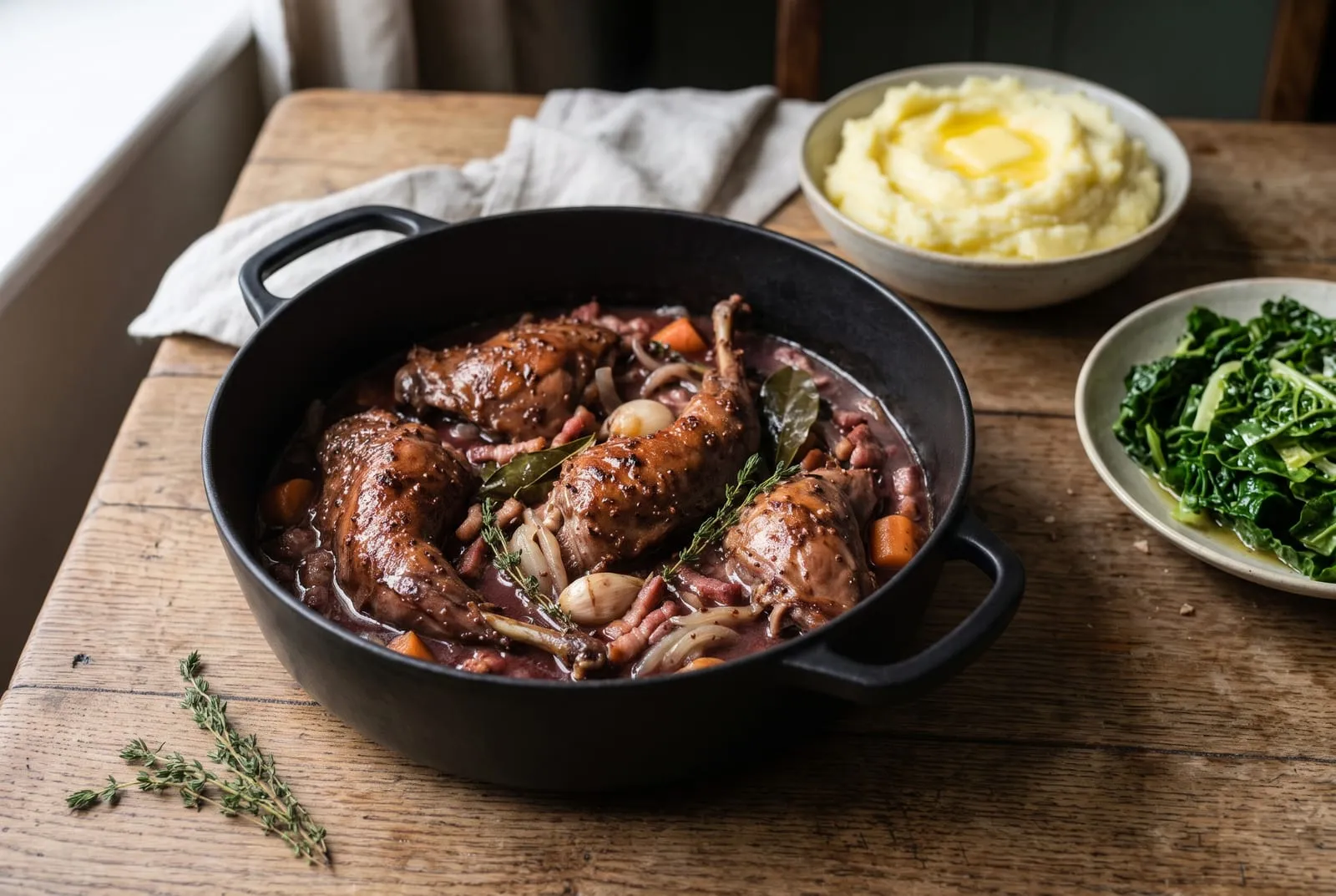
Braised pheasant legs with bacon and red wine
Eight pheasant legs braised in red wine with smoked bacon until the meat falls off the bone, with the hard tendons picked out. Cooked all the way through, as the FSA advises for game birds.
-
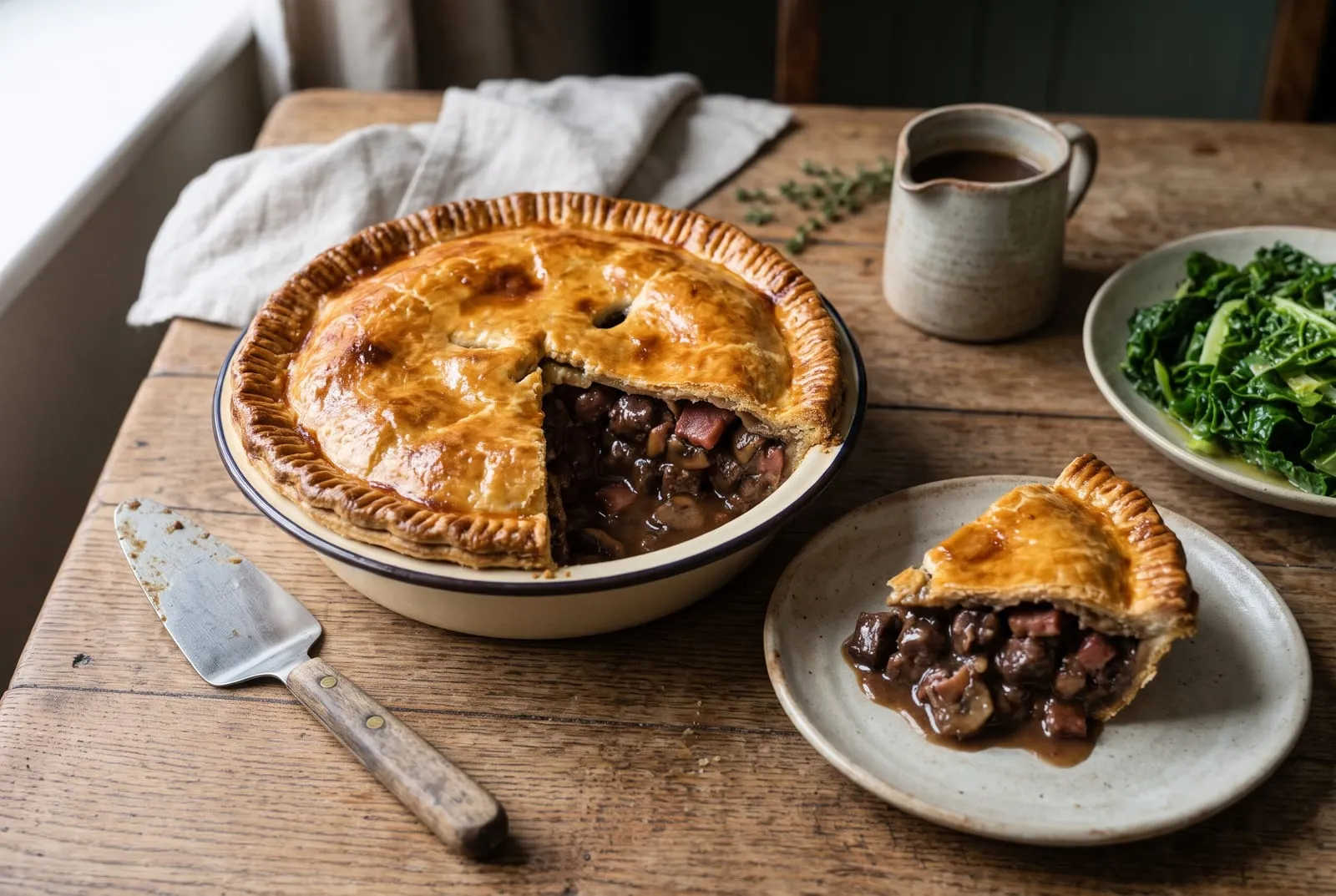
Game pie with venison and pheasant
Diced venison shoulder and pheasant slow-cooked in red wine with smoked bacon, mushrooms and juniper, cooled, then baked under a pastry lid. Freeze it unbaked to keep it.
-
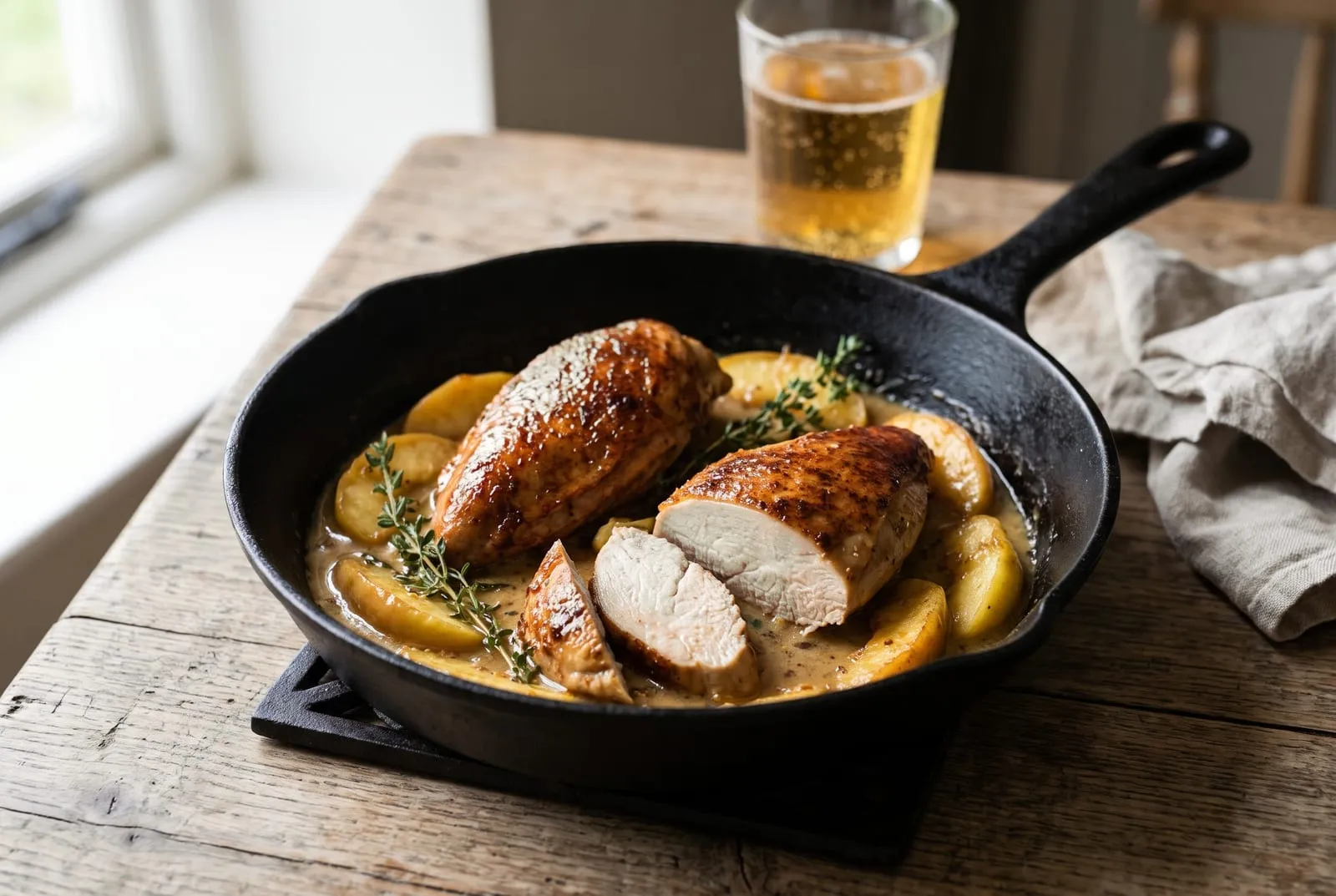
Pan-fried pheasant breasts, no plucking needed
Take the breasts off a brace without plucking or gutting, then pan-fry them in thyme butter with a quick apple, cider and cream sauce. Cooked through, as the FSA advises for game birds, and still juicy.