Game pie with venison and pheasant
Diced venison shoulder and pheasant slow-cooked in red wine with smoked bacon, mushrooms and juniper, cooled, then baked under a pastry lid. Freeze it unbaked to keep it.
- Serves 6
- Prep 45 min
- Cook 4 hr 50 min
- Total 5 hr 35 min
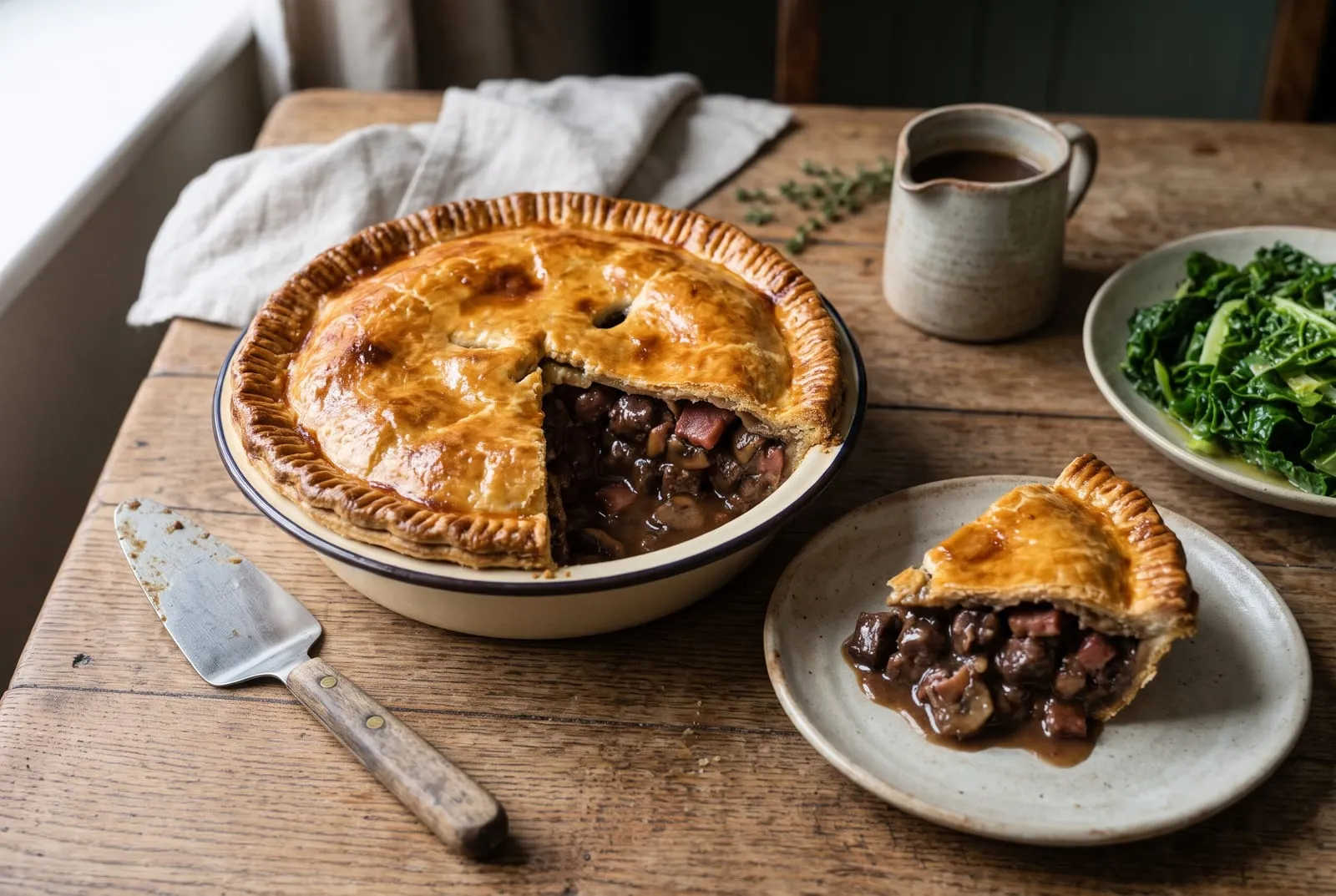
A game pie is a stew of mixed game under a pastry lid, and it works best when the filling is cooked first, cooled completely, then baked just long enough to brown the lid and heat the filling through. Venison shoulder and pheasant legs take about 2 hours, and the breast goes in near the end so it stays moist. The bake is the filling’s one reheat, so freeze a pie unbaked, not baked.
What goes in a game pie
Shoulder is the venison cut to use. The Countryside Alliance says tougher cuts such as shoulder, neck and shin should be braised or stewed slowly until they fall apart, which is what two hours in the pie does. Our slow-cooked venison shoulder recipe explains which deer to use and how to buy a shoulder.
Pheasant adds a lighter flavour. The legs need as long as the venison, so they go in from the start. The breasts go in for the last half hour because the Alliance warns that all game meat is lean and can dry out. Our braised pheasant legs recipe explains how to take the legs off and pick out the hard tendons, and our pan-fried pheasant breasts recipe shows how to breast a bird without plucking it. Wood pigeon is optional: its small, lean breasts go in with the pheasant breasts.
Buying game pie mix
If you don’t have a freezer full of game, buy diced mixed game, sold as game pie mix or game casserole mix by game dealers, butchers and some retailers. It saves the butchery and lets you buy as little as 500g. Abel & Cole’s 500g game pie mix, for example, is wild venison, pheasant and partridge in varying proportions, and its page warns that it may contain traces of shot, including lead.
Packs differ, so ask:
- which species are in it and in what proportions, since venison gives the stronger flavour
- whether it’s boneless
- whether it was shot with lead
- how long it was hung, which our guide to how long to hang meat explains.
Two 500g packs make a pie for six on their own. Skip the legs and the staged cooking: brown the meat in batches, put it all in together and cook it for the full 2 hours. Our wild game listings show the approved game handlers near you.
Using up the glut, and the freezer
BASC gives the pheasant season as 1 October to 1 February in England, Wales and Scotland, and, as our guide to shot pheasants, partridges and ducks explains, most pheasant shooting happens between November and January, so game tends to arrive in bulk. A pie takes odd amounts and mixed species without fuss, which makes it the place for the legs, the breasts of a couple of birds and the last of a shoulder. If you run a shoot with more birds than people to eat them, the same guide covers game dealers, selling birds direct and surplus birds.
Take birds apart as they come, and freeze the legs and breasts separately, in the form you’ll cook them. BASC says to press all the air out of the bag and to freeze game for six months at most, and the FSA says meat is usually best eaten within 2 to 3 months. Defrost in the fridge until completely thawed.
Venison isn’t tied to the pheasant season. The dates for wild deer are in our venison shoulder recipe, and Scotland sets its own. Farmed venison isn’t tied to them either.
Cooling the filling and the one reheat
The filling is the part that needs care. The FSA says to cool cooked food and get it into the fridge within one to two hours, and it calls the range from 8°C to 63°C the danger zone. A full casserole spends a long time there, so spoon the filling into a shallow dish, which cools faster than a deep pot, and chill it until completely cold. That also stops the butter in the pastry melting before the pie reaches the oven.
The bake is the filling’s one reheat. The FSA says to reheat leftovers only once, until steaming hot all the way through rather than just warmed. Once baked, a pie has had its reheat, so eat what’s left cold within 48 hours and don’t warm it again. A cold filling in a deep dish can take longer than 40 minutes to heat through, so go by the middle, not the pastry. A probe thermometer pushed through the steam hole should read at least 70°C, and the FSA’s test for fully cooked food is 70°C in the middle for 2 minutes.
To keep a pie, freeze it unbaked, so the bake is still its one reheat. Freeze the assembled pie, or the cooled filling in portions to top with fresh pastry later, and defrost it fully in the fridge, which the FSA calls the safest way. A large pie can take well over a night to defrost, partly defrosted food may not cook evenly, and the FSA says to use food within 24 hours of it being fully defrosted.
If you have picked leg meat left from our braised pheasant legs, stir it into the cold filling just before the pastry goes on, not into the hot casserole, so the bake is its one reheat.
Pastry: puff, shortcrust or hot water crust
Great British Chefs says puff pastry works best as a topping for pies, so puff makes the lightest lid. Shortcrust is sturdier and stands up to wet fillings, which makes it the better choice if you want a base as well, though the same page says a base needs baking blind so it doesn’t go soggy under a wet filling. Hot water crust is the usual pastry for a raised game pie and stands up to heavy fillings, but that’s a different job from a dish pie, so keep to puff or shortcrust here. Shop-bought all-butter pastry is fine.
Lead in mixed game
Pheasant, partridge, wood pigeon and deer all count as lead-shot game, so a mixed pie can carry lead from several sources. The FSA says to minimise how much of it you eat, especially small game, which matters most for toddlers, children, pregnant women and women trying for a baby. Its cooking advice says to avoid game birds in pregnancy, so this isn’t the pie for someone who’s pregnant. The large game sold in supermarkets is generally farmed, with no or very low lead, so a pie made only with farmed venison is the alternative.
The FSA’s wild game guidance says approved game handling establishments remove lead and the affected meat, though small amounts may remain, and that if you prepare game yourself you should remove as much lead as possible, with the meat around it. You can’t find pellets once meat is diced and braised, so go through every piece before it goes in the pot, and tell the table to bite carefully. A mixed pack is the hardest to check, so ask the dealer how it was shot.
Red wine is one more reason to find the shot first. A 2021 German study found that pigs absorbed 15% of the lead from lead-shot roe deer marinated in wine and vinegar before cooking, against 2.7% when it was only cooked. It tested marinades, not braises, and in pigs rather than people, so it doesn’t prove a wine braise does the same.
From 1 April 2029, lead shot can’t be used or sold in England, Wales and Scotland, apart from a few narrow exceptions, and lead bullets of 6.17mm calibre or more can’t be used for live quarry. Our guide to deer and wild game processing explains what changes.
What to serve with it
Mash or boiled potatoes soak up the gravy, and buttered cabbage, kale or cavolo nero add something green. Red cabbage and redcurrant jelly suit the juniper. Leftover pie is good cold the next day with a pickle, and should be eaten within 48 hours.
Game pie with venison and pheasant
- Serves 6
- Prep 45 min
- Cook 4 hr 50 min
- Total 5 hr 35 min
Ingredients
For the filling
- 450g diced venison shoulder, in 2.5cm pieces
- 4 pheasant breasts (from 2 birds), skinned and cut into 2.5cm pieces
- 4 pheasant legs (from the same 2 birds), skinned
- 2 wood pigeon breasts, cut into 2.5cm pieces (optional)
- Salt and freshly ground black pepper
- 2 tbsp rapeseed oil
- 150g smoked bacon lardons
- 2 onions, finely chopped
- 250g chestnut mushrooms, quartered
- 8 juniper berries, lightly crushed
- 6 sprigs of thyme
- 250ml red wine
- 400ml chicken or game stock
- 2 tbsp cornflour, mixed with 3 tbsp cold water
For the pie
- 375g ready-rolled all-butter puff pastry, or 320g shortcrust pastry
- Plain flour, for dusting
- 1 egg, beaten, for glazing
Method
- Heat the oven to 160°C (140°C fan), gas 3. Pat the venison and the pheasant breasts and legs dry with kitchen paper. Run your fingers over the pheasant and pigeon for shot and dig out any you find, then season everything with salt and pepper.
- Heat 1 tbsp of the oil in a large flameproof casserole over a medium heat. Fry the lardons for 6 to 8 minutes, stirring now and then, until golden and their fat has run. Lift them out with a slotted spoon and set aside.
- Turn the heat up to medium-high. Brown the venison in 3 batches, 4 to 5 minutes a batch, adding more oil if the pan dries, until it's deep brown, and set it aside with the lardons. Brown the pheasant legs for 3 to 4 minutes on each side and set them aside separately. Leave the breast and pigeon pieces raw for now.
- Turn the heat down to medium. Cook the onions for 8 to 10 minutes, stirring, until soft, then add the mushrooms and cook for 5 to 6 minutes more, until their liquid has gone. Add the juniper and thyme and cook for 1 minute.
- Pour in the wine and scrape up the browned bits from the bottom of the casserole. Let it bubble for 3 minutes, then add the stock. Return the venison, legs and lardons, with any juices from the plates, and bring to a simmer. Cover and cook in the oven for 1½ hours.
- Lift the legs onto a clean plate. When they're cool enough to hold, pull the meat off the bones, picking out the hard tendons from the drumsticks as described in our braised pheasant legs recipe, and throw away the bones and tendons. Stir the picked meat back into the casserole with the pheasant breast pieces and the pigeon, if using. Cover and cook for another 30 minutes, until the venison is tender and the breast pieces are cooked all the way through. If the venison still resists a fork, give it another 15 to 30 minutes.
- Put the casserole on the hob over a medium heat. Stir the cornflour and water together again, stir it into the filling and simmer for 2 to 3 minutes, until it's thick and glossy and a spoon dragged across the bottom leaves a clear trail. Take out the thyme stalks, then taste and season: the bacon and stock are salty.
- Cool the filling quickly. Spoon it into a shallow dish, spread it out and leave it until it stops steaming. Cover it and put it in the fridge within 2 hours of taking it off the heat, then leave it until it's completely cold, overnight if you can.
- Heat the oven to 200°C (180°C fan), gas 6, with a baking tray on the middle shelf. Spoon the cold filling into a 2 litre pie dish, mounding it slightly in the middle. Roll out the pastry on a floured surface to about 3mm thick and 4cm wider than the dish all round. Brush the rim of the dish with water, lay the pastry over the top and press the edges onto the rim. Trim, crimp with a fork, cut a steam hole in the middle and brush the lid with beaten egg.
- Bake the pie on the hot tray for 30 to 40 minutes, until the pastry is golden and the filling is piping hot in the middle. Push a probe thermometer through the steam hole: it should read at least 70°C. If the pastry browns before then, cover it with foil and bake for longer. Leave the pie to stand for 5 minutes before serving.
What you'll need
- Deep pie dish, about 2 litres The size the filling is measured for, so the lid sits on top rather than sinking.
- Rolling pin For the pastry lid, and for flattening breasts to an even thickness.
- Cast-iron casserole dish Goes from hob to oven, and holds a steady heat for long, slow cooking.
- Probe thermometer Checks the middle of the meat rather than guessing. Keep the tip away from the bone.
- Juniper berries The classic spice with venison and game. A jar lasts for years.
These are Amazon links. If you buy through them, Lairage may earn a small commission at no extra cost to you.
Questions people ask
What meat goes in a game pie?
This one uses diced venison shoulder and pheasant, with wood pigeon as an option. Venison shoulder and pheasant legs need about 2 hours, so they go in from the start, while lean breast meat goes in for the last 30 minutes to keep it moist. A dealer's game pie mix is a ready-diced alternative.
What is game pie mix?
Diced mixed game, sold by game dealers, butchers and some retailers for pies and casseroles. The species and proportions vary from pack to pack, and packs can contain traces of lead shot. Ask what is in it, whether it is boneless, how it was shot and how long it was hung. Two 500g packs make a pie for six.
Can you freeze game pie?
Yes, but freeze it unbaked. Baking is the filling's one reheat, and the FSA says to reheat food only once, so a baked pie shouldn't be reheated again. Assemble the pie with a completely cold filling, freeze it, defrost it fully in the fridge, then bake it within 24 hours until steaming hot all the way through. Meat is usually best eaten within 2 to 3 months.
How long does game pie take to bake?
30 to 40 minutes at 200°C (180°C fan), gas 6, when the filling goes in cold, until the pastry is golden and the filling is steaming hot all the way through. A deep dish can take longer. Push a probe thermometer through the steam hole: it should read at least 70°C in the middle, and if the pastry browns first, cover it with foil.
Should game pie have shortcrust or puff pastry?
Either works. Puff makes the lightest lid and works best as a topping for pies. Shortcrust is sturdier and stands up to wet fillings, so it suits a pie with a base as well, which needs baking blind first. Hot water crust is the usual pastry for a raised game pie, which is a different job from a dish pie.
Sources
- Food Standards Agency: Cooking your food
- Food Standards Agency: How to chill, freeze and defrost food safely
- Food Standards Agency: Eating lead-shot game
- Food Standards Agency: The Wild Game Guidance
- The REACH (Amendment) Regulations 2026 (SI 2026/195): lead in ammunition
- BASC: Freezing game
- BASC: Shooting seasons
- Countryside Alliance: Cooking tips
- Great British Chefs: How to choose pastry
- Great British Chefs: How to make a hot water crust pastry
- Abel & Cole: Wild game pie mix (500g)
- Schulz K and others (2021): Marination increases the bioavailability of lead in game meat shot with lead ammunition, Journal of Nutritional Science 10, e24
This recipe is general information. Follow the Food Standards Agency's advice on cooking meat safely, and on eating game shot with lead if you eat it often.
More recipes
-
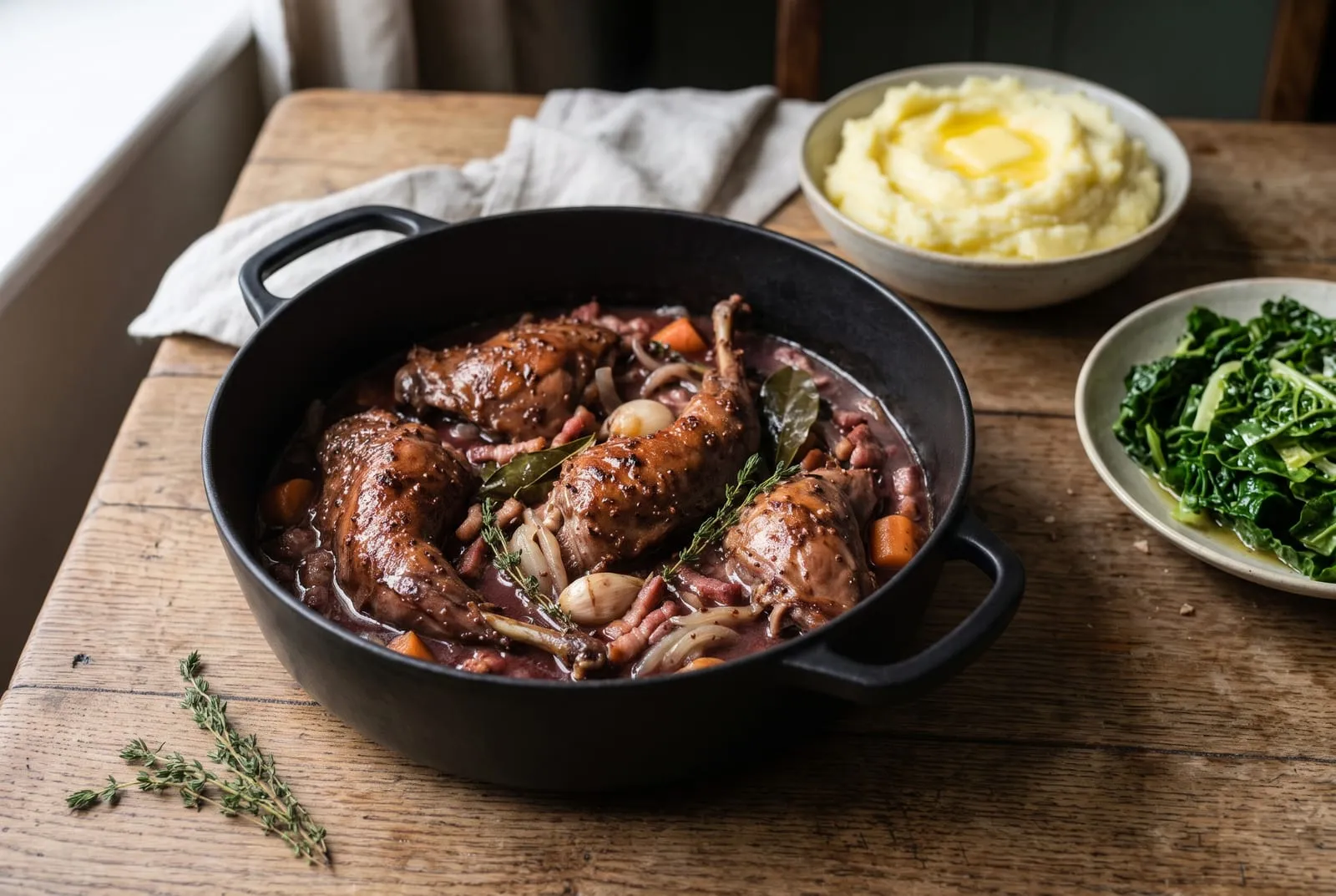
Braised pheasant legs with bacon and red wine
Eight pheasant legs braised in red wine with smoked bacon until the meat falls off the bone, with the hard tendons picked out. Cooked all the way through, as the FSA advises for game birds.
-
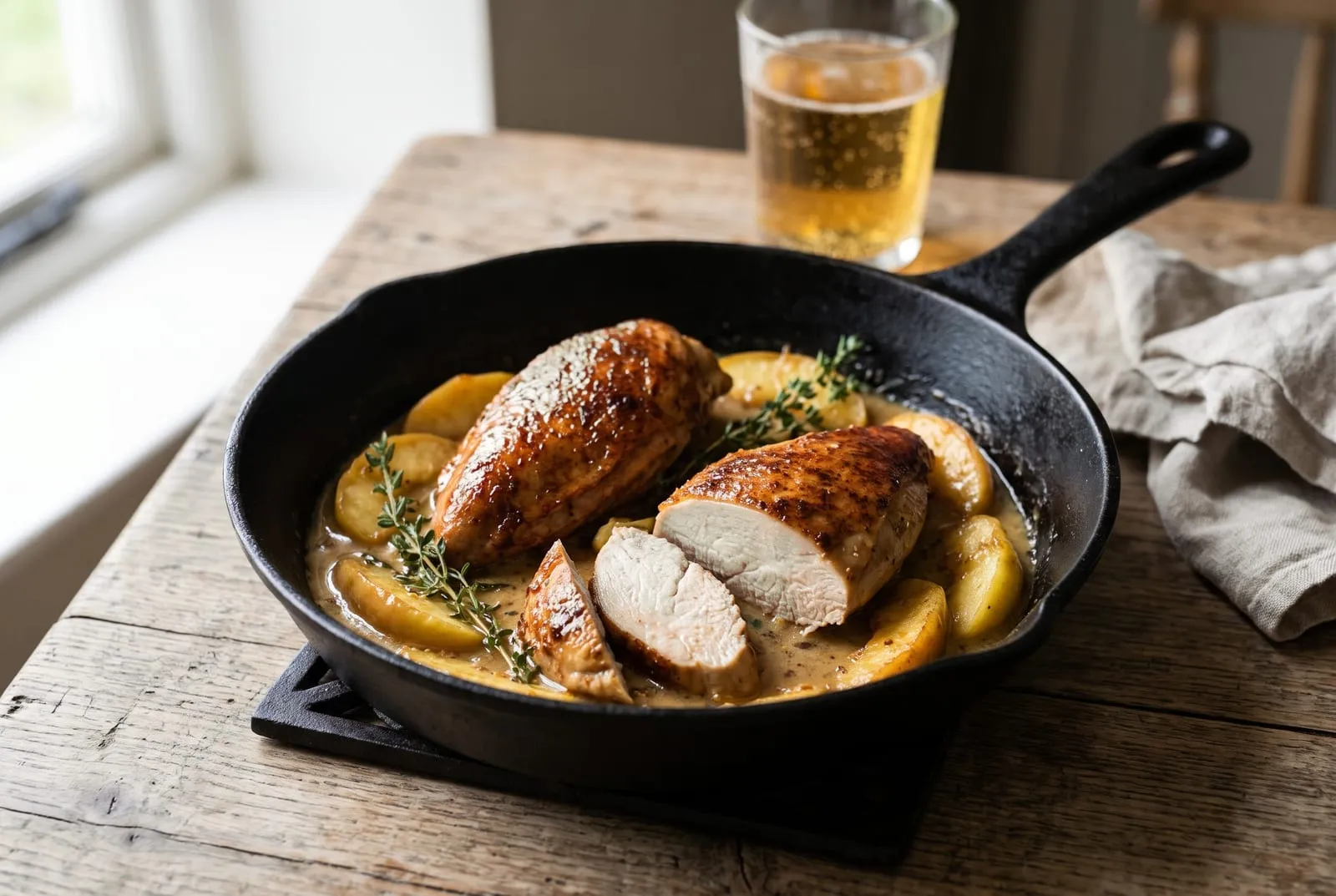
Pan-fried pheasant breasts, no plucking needed
Take the breasts off a brace without plucking or gutting, then pan-fry them in thyme butter with a quick apple, cider and cream sauce. Cooked through, as the FSA advises for game birds, and still juicy.
-
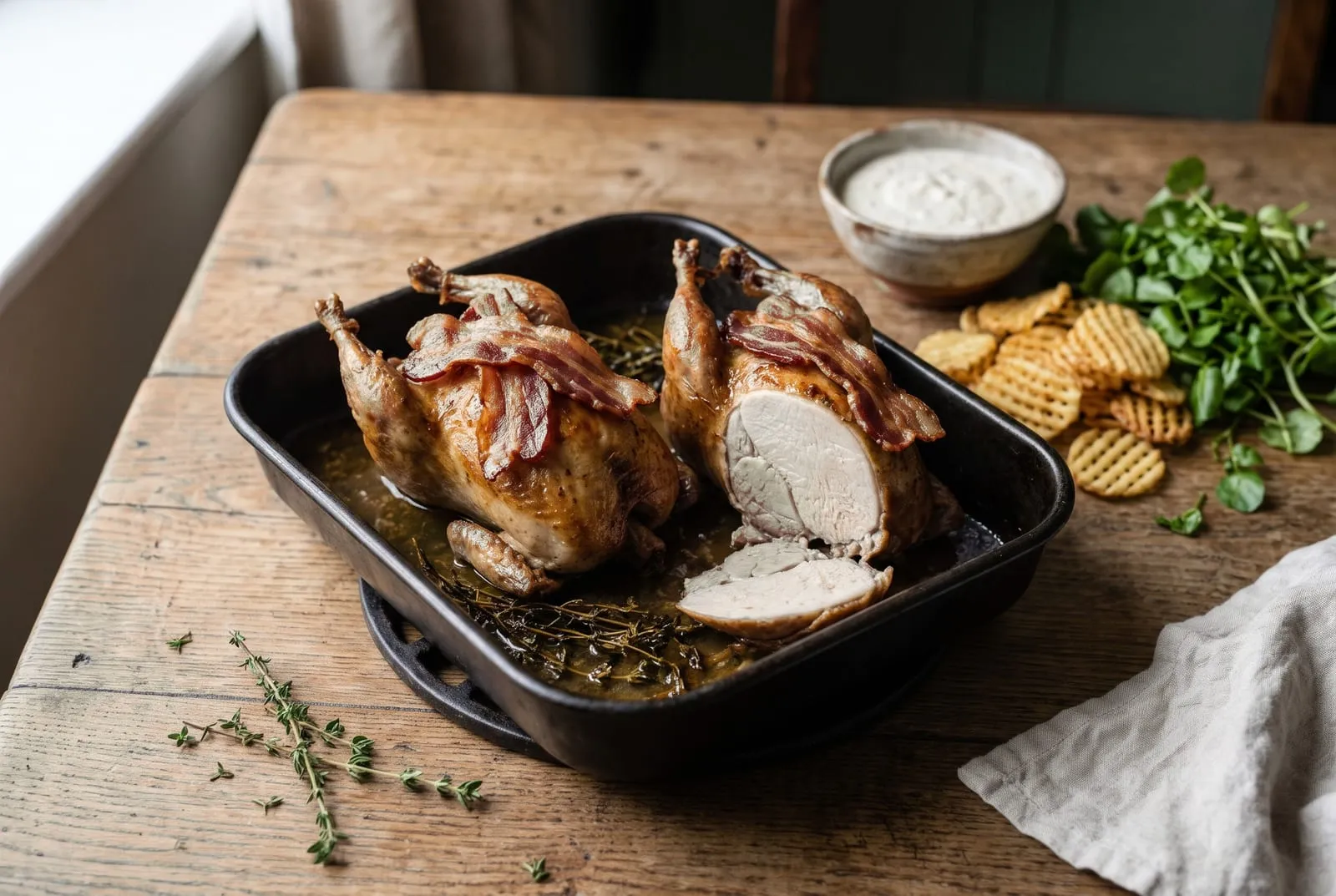
Roast partridge with bacon
Two partridges browned in a pan, covered with streaky bacon and roasted until cooked through, then rested and served with pan gravy, bread sauce, game chips and watercress.