Pan-fried pheasant breasts, no plucking needed
Take the breasts off a brace without plucking or gutting, then pan-fry them in thyme butter with a quick apple, cider and cream sauce. Cooked through, as the FSA advises for game birds, and still juicy.
- Serves 2
- Prep 20 min
- Cook 20 min
- Total 40 min
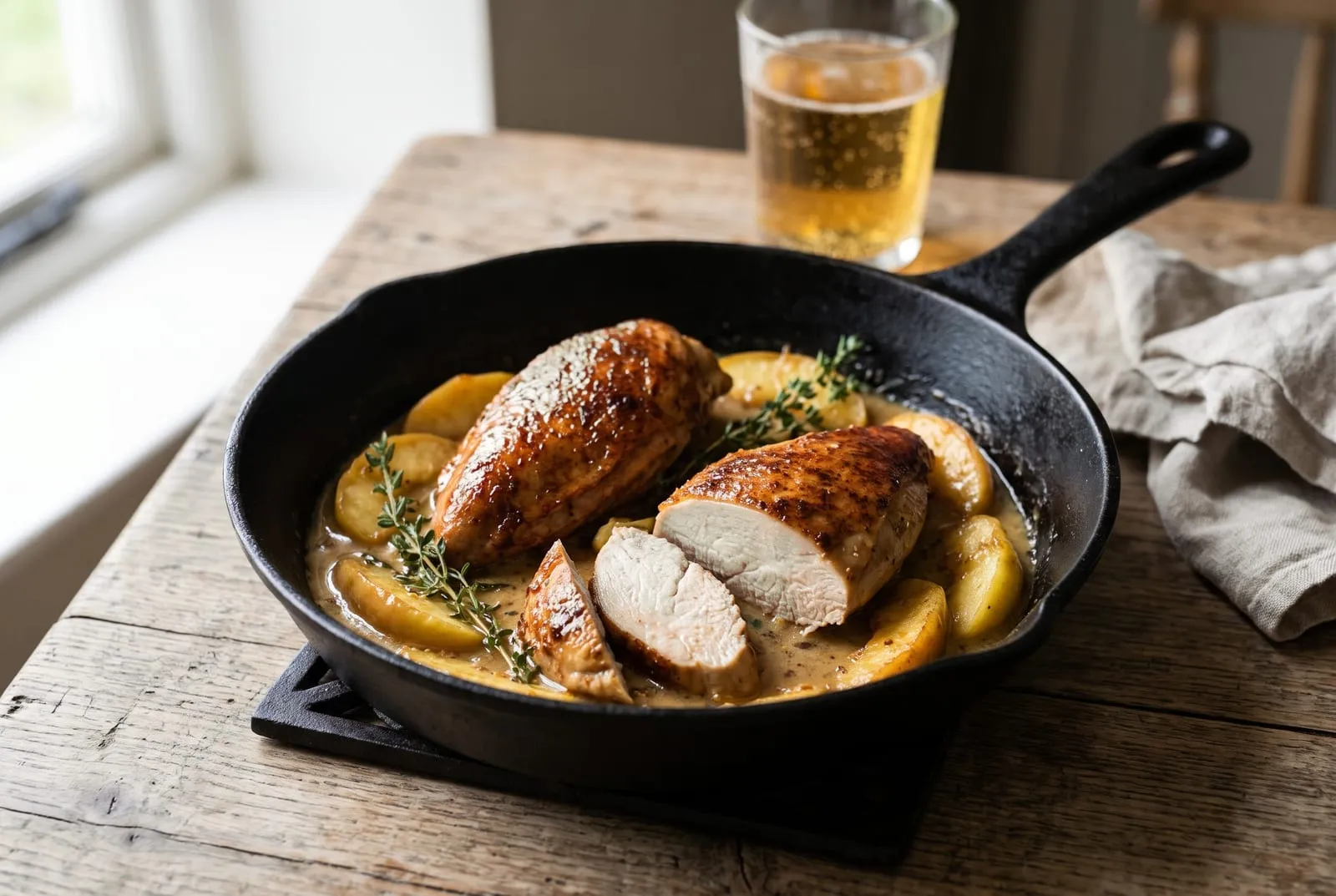
You don’t need to pluck or gut a pheasant to cook the breasts. Peeling back the skin and feathers and cutting the breasts off takes a few minutes a bird and gives you the best meat on it, ready for a hot pan. It’s the quick way to deal with the brace that, under the Code of Good Shooting Practice, shoot managers should always offer Guns, and Guns should accept.
How to breast a pheasant without plucking it
The breast meat sits on the outside of the ribcage, so you never open the body and there’s no gutting. Work on a board kept for raw meat, as the FSA advises, and wash your hands and the board when you’ve finished.
- Lay the bird on its back on the board and find the breastbone, the ridge running down the middle of the chest.
- Pinch the skin over the breastbone and tear it open with your fingers. Pheasant skin is soft and rips easily, so you can peel it back to either side, feathers and all, until both breasts are uncovered. Stop short of the crop, the pouch at the base of the neck, which may be full of grain.
- Run the tip of a boning knife down one side of the breastbone, keeping the blade against the bone. Work outwards over the ribs in long, shallow strokes, easing the meat away as you go.
- Where the breast meets the wing, cut through the joint, or snip it with poultry shears, and lift the breast away. Repeat on the other side.
- For the legs, peel the skin off each thigh, bend the leg back until the hip joint pops, and cut through it. Cut off the foot at the joint below the drumstick.
- Check every piece for shot, feathers and bruised or bloodshot meat, and cut away anything damaged. There’s more on finding shot below.
- Wipe the meat with damp kitchen paper rather than washing it under the tap. The FSA says washing raw poultry doesn’t get rid of bacteria, and can splash them onto your hands, worktop and equipment.
Young or old, hen or cock
Pan-frying suits a young bird. The Countryside Alliance’s cooking tips say young birds bought before Christmas are generally more tender and best roasted or grilled, while older birds are better cooked slowly, in a casserole or braise. If you think a bird is old, save it for a slow cook.
Its guide to ageing your game says the quickest check is the spurs on the back of the legs. A young pheasant’s are light in colour, soft and fairly blunt; an older bird’s are darker, harder and sharp. A Game and Wildlife Conservation Trust study notes that spurs only work for cocks, and are fairly reliable until December, after which young and old birds’ spurs overlap. For hens, it describes a test that works on any pheasant, the bursa, a small pouch opening just above the vent: usually 15 to 40mm deep in a young bird, and very shallow or closed in an adult. You can gauge the depth with a matchstick. The bursa starts to shrink in young birds after January.
A brace is usually a cock and a hen, says the Countryside Alliance, and the cock is bigger. In a 2026 Slovak study of 40 pheasants reared under natural conditions, the cocks carried about 355g of breast meat each and the hens about 243g. The cock’s breasts will take longer, so that’s the one to check with the probe.
Hanging
Hanging is a personal preference, says the Countryside Alliance. Its Game to Eat campaign suggests 5 to 7 days at about 5°C for game birds, but not hanging a bird that’s gut shot or badly damaged. A game dealer told BASC that birds are generally prepared 2 to 5 days after the shoot. Our guide to how long to hang meat has the detail. If you’ve bought birds oven-ready, or bought breasts, you can skip this.
Shot and lead
The FSA says people who often eat game shot with lead, particularly small game such as pheasant, should cut down, because lead can harm the developing brain and nervous system. That matters most for toddlers, children, pregnant women and women trying for a baby. Its cooking advice says to avoid game birds altogether during pregnancy, because the meat may contain lead shot.
Not all game is shot with lead. The FSA says the large game sold in supermarkets is generally farmed, with no or very low lead, but pheasant is small game, so if you’re not sure how a bird was shot, ask your supplier. The rules are changing too: under regulations made in March 2026, lead shot can’t be used or sold in England, Wales and Scotland after 1 April 2029, apart from a few narrow exceptions. Our guide to deer and wild game processing explains what changes.
If you prepare game yourself, the FSA’s wild game guidance says to remove as much lead as you can, with the meat around it. To find it:
- Look for small dark holes in the meat, often with a bruise around them.
- Run your fingertips over both sides of each breast to feel for hard lumps.
- Dig each pellet out with the tip of a small knife or fish-bone tweezers, and pull out any feather it dragged in.
- Trim off the bloodshot meat around the track.
It’s easy to miss a pellet, so tell everyone at the table to bite carefully.
Cooking it through without drying it out
Pheasant breast has almost no fat to keep it moist. The 2026 study found pheasant meat very low in intramuscular fat, and the Countryside Alliance warns that all game is lean and can dry out in cooking.
It still has to be cooked through. The FSA counts game birds as poultry, with chicken, turkey and duck, which can have bacteria all the way through the meat. Its test for food that’s fully cooked is 70°C in the middle for 2 minutes, or an equivalent such as 65°C for 10 minutes or 75°C for 30 seconds. Without a thermometer, check there’s no pink meat and the juices run clear. The same page says bird flu is a very low food safety risk, and properly cooked game birds are safe to eat.
So the recipe keeps the breasts juicy by technique, not by serving them pink:
- Even thickness. Flattening the thick end means the thin end doesn’t dry out while the middle catches up.
- A hot pan. The outside browns in minutes, before the inside overcooks.
- Stop at done. A probe thermometer tells you when the middle reaches 70°C, so you don’t cook past it. Push it in from the side to the middle of the thickest breast, and clean it after each use, as the FSA advises.
- A short rest and the sauce. A few minutes on a warm plate while you make the sauce, then cream and apple to make up for the missing fat.
Using the rest of the bird
The legs are worth taking. They’re tougher than the breasts and full of fine tendons, so they suit slow cooking, such as braising in stock or cider until the meat falls off the bone, or the stockpot. Like the breasts, they need cooking all the way through.
The carcass, with the guts still in, can go out with your household rubbish. The FSA’s best practice for game waste such as guts includes double-bagging it for a general waste bin. Don’t give any of it to pigs or poultry, even pets: APHA says it’s illegal to feed kitchen scraps, meat or meat products to farmed animals.
Where to get pheasant
If you don’t shoot, try a game dealer, a butcher or a farmers’ market. Fresh birds are easiest to find in the shooting season, which BASC gives as 1 October to 1 February in England, Wales and Scotland, and 1 October to 31 January in Northern Ireland. Our wild game listings show the approved game handlers near you.
Running a shoot with more birds than the Guns will take home? Our guide to where to take shot pheasants, partridges and ducks covers game dealers, selling birds direct and surplus birds.
A brace gives you four breasts, about 600g of meat for a cock and a hen, going by the 2026 study. A game dealer told BASC that approved game handling establishments have to pluck a pheasant completely before taking any meat off it, so breasts from a dealer may come with the skin on. Pull it off for this recipe. Whoever you buy from, ask whether the birds were shot with lead.
What to serve with it
Serve it with something to soak up the sauce, such as mashed potato, celeriac mash or crusty bread, and a green vegetable such as buttered cabbage, kale or green beans. The rest of the bottle of cider goes well with it.
Pan-fried pheasant breasts, no plucking needed
- Serves 2
- Prep 20 min
- Cook 20 min
- Total 40 min
Ingredients
- 4 pheasant breasts (from a brace), skinned
- 1 tbsp plain flour
- Salt and freshly ground black pepper
- 1 tbsp rapeseed oil
- 25g butter
- 4 sprigs of thyme
For the sauce
- 15g butter
- 1 eating apple, such as Cox or Braeburn, cored and cut into 12 slices
- 150ml dry cider
- 100ml double cream
- 1 tsp Dijon mustard
Method
- If you're starting with whole birds, take the breasts off first, as described above. Pat the breasts dry with kitchen paper and feel them over once more for shot. Lay them between two sheets of baking paper and tap the thick end with a rolling pin until each breast is an even thickness, about 1.5cm at its thickest. Season both sides with salt and pepper, then dust lightly with the flour and shake off the excess.
- Heat the oil in a heavy frying pan over a medium-high heat for about 2 minutes, until it shimmers. Lay the breasts in, smooth side down, with space between them. Leave them alone for 3 minutes, until the underside is golden brown and they lift away from the pan easily.
- Turn the breasts over, turn the heat down to medium and add the 25g of butter and the thyme. When the butter foams, tilt the pan and spoon it over the breasts for 3 minutes. If the butter smells burnt rather than nutty, turn the heat down.
- Push a probe thermometer into the side of the thickest breast, to the middle. A cock's breasts are bigger than a hen's, so check one of those. When it reads 70°C, turn the heat to low and keep basting for 2 minutes more, so the middle holds 70°C for 2 minutes, the FSA's test for food that's fully cooked. If it isn't at 70°C yet, cook for another minute and check again. Without a probe, cut into the thickest part: there should be no pink meat, and the juices should run clear.
- Lift the breasts onto a clean, warm plate, not the board they were prepared on. Cover loosely with foil and leave to rest while you make the sauce.
- If the butter in the pan has burnt, wipe it out with kitchen paper; otherwise leave it, and the thyme, in the pan. Add the 15g of butter, turn the heat back up to medium and fry the apple slices for about 2 minutes a side, until golden at the edges but still holding their shape.
- Pour in the cider, which will hiss and spit. Let it bubble for 2 to 3 minutes, scraping up the browned bits from the bottom of the pan, until it has reduced by about half.
- Stir in the cream and mustard and simmer gently for 1 to 2 minutes, until the sauce is thick enough to coat the back of a spoon. Tip in any juices from the resting plate, take out the thyme stalks and season to taste.
- Serve the breasts whole or thickly sliced, with the apples and sauce spooned over.
What you'll need
- Boning knife A thin, stiff blade that follows the bone.
- Poultry shears Snips through wing and leg joints, and halves small birds.
- Fish-bone tweezers Pulls out stray feathers, shot and pheasant leg tendons.
- Disposable nitrile gloves For skinning, breasting and plucking.
- Heavy frying pan Cast iron or thick steel stays hot when cold meat goes in, so it browns rather than stews.
- Probe thermometer Checks the middle of the meat rather than guessing. Keep the tip away from the bone.
These are Amazon links. If you buy through them, Lairage may earn a small commission at no extra cost to you.
Questions people ask
How long do pheasant breasts take to cook?
Skinned breasts flattened to about 1.5cm take 8 to 10 minutes in a hot pan, including 2 minutes holding the middle at 70°C, then a few minutes' rest. Go by a probe thermometer rather than the clock, because a cock's breasts are bigger than a hen's.
Can you eat pheasant pink?
No. The FSA counts game birds as poultry, like chicken, turkey and duck, which can have bacteria all the way through the meat, so they need cooking all the way through. That means no pink meat, juices that run clear, and 70°C in the middle for 2 minutes, or an equivalent such as 75°C for 30 seconds.
Do you have to pluck a pheasant?
No. For the breasts, and the legs if you want them, you can peel the skin and feathers back and cut the meat off without plucking or gutting the bird. You only need to pluck it if you want to cook it whole or with the skin on.
How do you get shot out of a pheasant?
Look for small dark holes and bruising, feel for hard lumps, and dig the shot out with the tip of a small knife or fish-bone tweezers, along with any feather it carried in. The FSA advises removing as much lead as you can, with the meat around it. Pellets are easy to miss, so tell people to bite carefully.
Where can you buy pheasant?
Try game dealers, butchers and farmers' markets. Fresh birds are easiest to find in the shooting season, which runs from 1 October to 1 February in England, Wales and Scotland. If you're not sure whether the birds were shot with lead, the FSA suggests asking your supplier.
Sources
- Food Standards Agency: Cooking your food
- Food Standards Agency: Eating lead-shot game
- Food Standards Agency: Why avoiding cross-contamination is important
- Food Standards Agency: The Wild Game Guidance
- Code of Good Shooting Practice: The Code of Good Shooting Practice, section 4, Game is food
- Countryside Alliance: Ageing your game
- Countryside Alliance: Cooking tips
- Countryside Alliance: Plucking your game
- Countryside Alliance: Hanging your game
- BASC: Food for thought, an expert's advice on good game handling (17 November 2025)
- BASC: Shooting seasons
- Woodburn MIA and others (2009): Age determination of pheasants using discriminant analysis, Gamebird 2006 (Game and Wildlife Conservation Trust)
- Haščík P and others (2026): The meat yield and physicochemical composition of Phasianus colchicus, Acta Universitatis Agriculturae et Silviculturae Mendelianae Brunensis 74(3)
- The REACH (Amendment) Regulations 2026 (SI 2026/195): lead in ammunition
- Animal and Plant Health Agency: APHA warns not to feed kitchen scraps to farm animals because of disease risk (11 January 2017)
This recipe is general information. Follow the Food Standards Agency's advice on cooking meat safely, and on eating game shot with lead if you eat it often.
More recipes
-
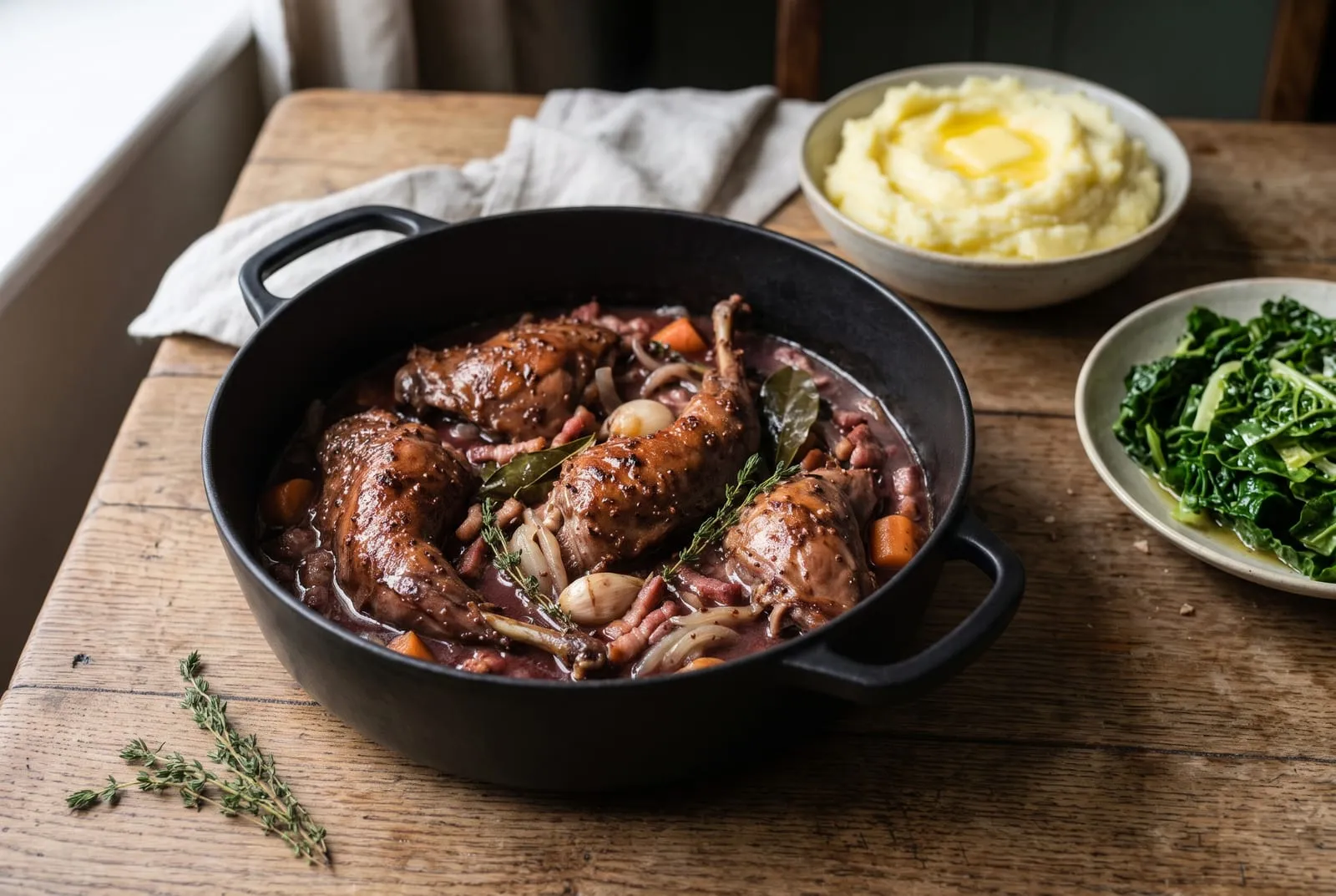
Braised pheasant legs with bacon and red wine
Eight pheasant legs braised in red wine with smoked bacon until the meat falls off the bone, with the hard tendons picked out. Cooked all the way through, as the FSA advises for game birds.
-
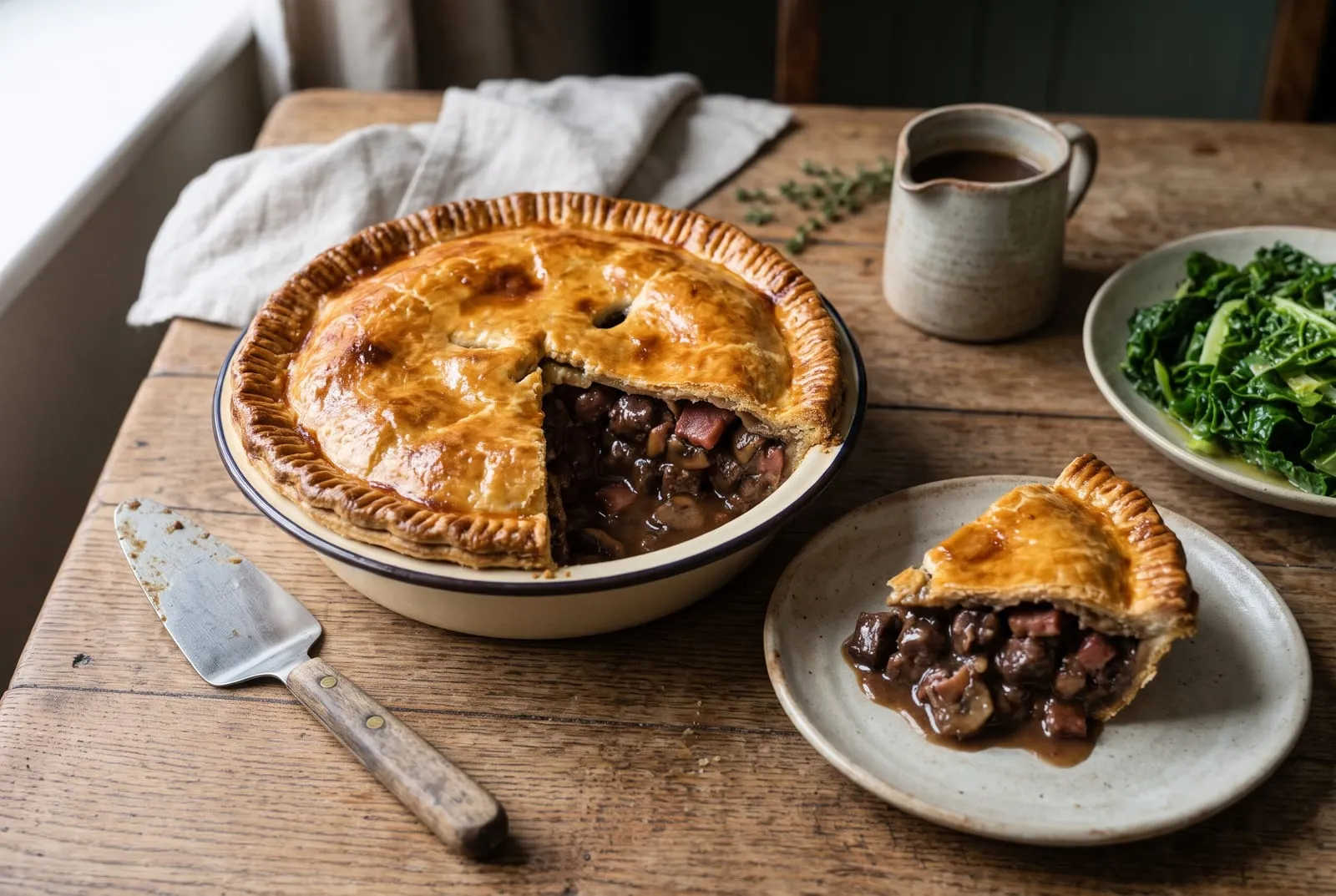
Game pie with venison and pheasant
Diced venison shoulder and pheasant slow-cooked in red wine with smoked bacon, mushrooms and juniper, cooled, then baked under a pastry lid. Freeze it unbaked to keep it.
-
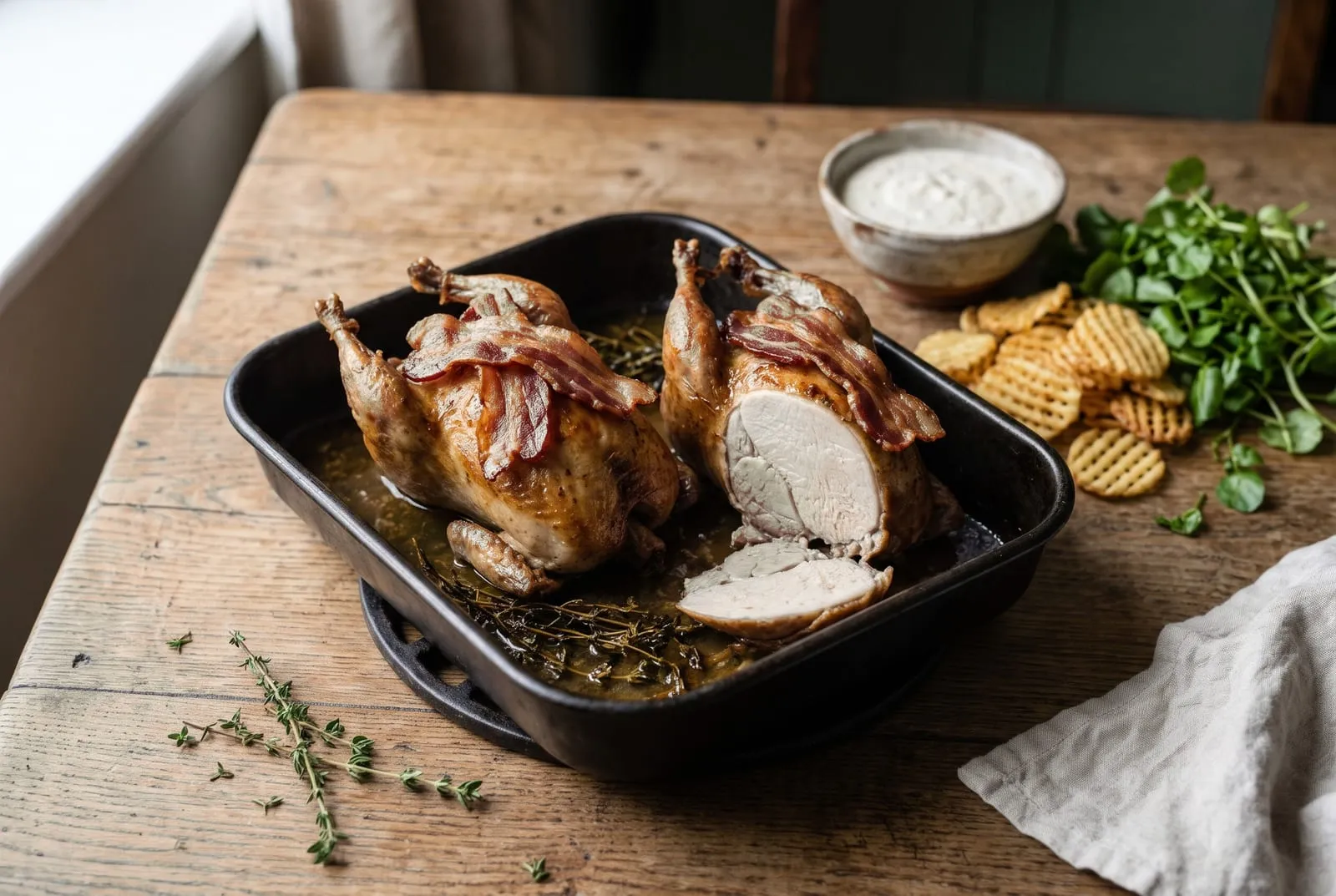
Roast partridge with bacon
Two partridges browned in a pan, covered with streaky bacon and roasted until cooked through, then rested and served with pan gravy, bread sauce, game chips and watercress.