Christmas private kill: when to book, kill and collect
To have your own beef, lamb or pork for Christmas, work back from the day you want to collect it. Take off the time the abattoir needs to cut and pack it, then the hanging time: AHDB recommends 7 to 21 days for beef and 7 to 10 for lamb. That gives you the kill date. Small abattoirs can be booked up weeks ahead before Christmas, so book that date as early as you can, check when your abattoir closes for the holidays, and if you can’t get a December slot, kill earlier and freeze the meat.
How early to book for Christmas
As early as you can. Small abattoirs can be hard to book at any time of year: in May 2025 the Farmers’ Union of Wales said farmers had to book several weeks ahead to be sure of a slot, and one respondent to a 2025 survey of abattoir users said they book “in some cases up to a year in advance”.
The run-up to Christmas is busier still:
- Down Land Traditional Meats in Henfield, West Sussex, told a pig-keeping blogger, writing on 2 November 2026, that its pig bookings were almost full for the rest of the year. It keeps a waiting list for cancellations and has added extra pig days.
- In January 2024, FarmingUK reported that a butcher’s shop in Cumbria, where only two abattoirs offer private kill, couldn’t get its animals slaughtered in the run-up to Christmas.
- Accidental Smallholder warns that some abattoirs won’t do private kills at all in late autumn because of the pre-Christmas rush.
- For sheep, the national figures point the same way: on average over 2022 to 2025, October, November and December were the three busiest months for sheep and lamb slaughter in the UK, in Defra’s monthly statistics.
How far ahead your abattoir fills up varies, so ask. Work out your latest kill date first (see below), then ring with it.
Christmas and New Year closures
We couldn’t find an abattoir in England or Wales that publishes its Christmas and New Year closure dates, so ask yours. The Christmas and New Year bank holidays in England and Wales in 2026 are:
- Friday 25 December, Christmas Day
- Monday 28 December, the substitute day for Boxing Day, which falls on a Saturday
- Friday 1 January 2027, New Year’s Day
Source: GOV.UK.
Count kill days, not calendar days. Some abattoirs don’t kill every weekday even in a normal week: Langford Abattoir near Bristol is open Monday to Thursday and closed on Fridays. Mobile units may kill less often still: Fir Farm’s mobile unit in Gloucestershire has monthly kill dates, with the last of 2026 on 16 December and the next on 20 January 2027.
Ask for four dates: the last kill day for your animals, the last day for cutting lists, the last day and time to collect, and the day they open again in January.
Why the kill date comes so early
Meat isn’t ready on the day it’s killed. The carcase has to chill and hang, then be cut, packed and collected, and all of that has to happen before the abattoir shuts for Christmas.
Hanging
- Beef: AHDB recommends at least 7 days for hindquarter cuts from steers and heifers, at least 14 for forequarter cuts and young bulls, and 21 days for the best tenderness (AHDB).
- Lamb: at least 7 days, and ideally 10.
- Pork: there’s no official figure. Quality Meat Scotland’s private kill handbook gives 1 to 3 days, and J Broomhall in Gloucestershire hangs pork for 4 to 14 days as standard.
Abattoirs often hang for longer than the minimum. J Broomhall’s standard is 21 to 28 days for beef and 10 to 14 for lamb, so ask how long yours hangs before you pick a kill date. Our guide to how long to hang meat explains what hanging does and what it costs.
Cutting, packing and curing
Cutting comes after hanging, and it takes time too. H J Hellett & Sons in Cambridgeshire says its turnaround is within 7 days for pigs and sheep and 14 days for cattle, unless you arrange longer hanging for beef. Butchers get busy before Christmas as well: Accidental Smallholder warns that they may not take private kills in December, or even before.
Send your cutting list early. Martins Meats in Gloucestershire does a standard cut if your instructions haven’t arrived before cutting. Our guide to cutting lists shows what to put on one.
Curing adds more time. The Village Butchers in Essex dry-cures its Christmas gammons for 7 to 10 days, and a West Dorset farmer selling their own pork tells buyers that gammon and bacon take 3 to 4 weeks to cure (Broadwindsor.org). If you want a gammon for Christmas, ask whether your abattoir or butcher cures, and how long it takes.
Pork: the Trichinella test
Unless your holding is officially recognised as having controlled housing, your pigs are tested for the Trichinella parasite, and no meat can leave the abattoir until the result is negative (FSA Manual for Official Controls, chapter 2.4). AHDB says pigs that live outdoors until they go for slaughter are unlikely to count as controlled housing.
The result usually comes back the next day. The FSA says samples can be collected on the day of slaughter, if the courier is booked in advance, and results are sent back by 6pm the following day. But the FSA’s manual says the courier doesn’t normally collect on Fridays, so if your pig is killed late in the week, ask when it will be released.
Work back from the day you want the meat
- Pick your collection day. It has to fall before your abattoir closes for Christmas, and on a day it’s open.
- Take off cutting and packing time. Ask your abattoir or butcher how long they need in December.
- Take off the hanging time for each meat, from the list above.
- For pork, allow a day for the Trichinella result, and longer for curing if you want a gammon or bacon.
- That’s your latest kill date. Book it now, and ask to go on the cancellation list if it’s full.
- Then work back the paperwork. Check that every medicine withdrawal period ends before the kill date. Order pig ear tags early: Accidental Smallholder warns you may have to order them several weeks ahead. Have the movement paperwork ready before the day: passports for cattle, a movement document through the Livestock Information Service or EIDCymru for sheep, and an eAML2 licence for pigs.
Latest kill dates for Christmas 2026
Say you want to collect on Monday 21 December 2026. Counting back the hanging time alone gives these latest kill dates:
| Meat | Hanging time | Kill by |
|---|---|---|
| Beef | 21 days, AHDB’s figure for the best tenderness | Monday 30 November |
| Beef | 14 days, AHDB’s minimum for forequarter cuts | Monday 7 December |
| Lamb | 10 days, AHDB’s ideal | Friday 11 December |
| Lamb | 7 days, AHDB’s minimum | Monday 14 December |
| Pork | 4 to 14 days, as at J Broomhall | Monday 7 to Thursday 17 December |
Now take off the days your abattoir needs to cut and pack, and any days it doesn’t kill. The real date will be earlier. At Hellett’s turnaround of 7 days for pigs and sheep and 14 for cattle, collecting on Monday 21 December means killing lamb or pork by Monday 14 December and beef by Monday 7 December.
Collecting before Christmas
Agree the collection day when you book, not when the meat is ready. Ask:
- what’s the last day and time you can collect before Christmas
- how long they’ll keep the meat if you’re held up, and whether that costs extra
- whether they deliver, and the last day they can
Offal can’t wait for the rest of the carcase. Down Land’s owner told South East Farmer in 2023 that offal has to be collected ideally the day after the kill, so if your beef is hanging for three weeks, plan two trips.
Take enough cool boxes for all of it, or a chilled vehicle, and get the meat into the fridge or freezer as soon as you’re home.
Keeping it until Christmas Day
Make room first. The FSA suggests planning fridge and freezer space before Christmas and checking with a fridge thermometer that your fridge is at 5°C or below (FSA). Keep raw meat covered on the bottom shelf, away from food that’s ready to eat.
Freezing. The FSA says a freezer at around -18°C acts as a pause button: food won’t go bad and most bacteria can’t grow. For quality, it says meat is usually best eaten within 2 to 3 months (FSA). So a kill in October or November still gives you meat for Christmas. Wrap it well or vacuum pack it to stop freezer burn, and label every pack.
Defrosting. Defrost in the fridge, not at room temperature. The FSA’s advice for a turkey, which it also points to for other large cuts of meat, is to allow around 10 to 12 hours per kg in the fridge when there are no instructions on the pack. A 6 to 7 kg turkey can take as much as 4 days. Once meat has defrosted, cook and eat it within 24 hours, and don’t refreeze it raw.
If you can’t get a December slot
- Kill earlier and freeze. Frozen in October or November, the meat is still within the FSA’s 2 to 3 months for best quality at Christmas.
- Ask to go on a cancellation list, and how much notice you’d get. Down Land, for one, keeps a waiting list for cancellations.
- Try other abattoirs, including mobile units. Use the finder, or see every abattoir that takes cattle, sheep or pigs. Fir Farm’s mobile unit takes up to 30 lambs or pigs on each of its monthly kill days, and our guide to mobile abattoirs explains how they work.
- Split the job. If an abattoir can kill but can’t cut in time, ask whether it will deliver the carcase to a butcher. Book the butcher early too.
What to ask your abattoir about Christmas
- What’s the last kill day before Christmas for my animals, and is it full yet?
- When do you need my cutting list?
- How long will you hang the carcase, and when will it be cut?
- For pork, when will the Trichinella result be back, and is there time to cure a gammon?
- What’s the last day and time I can collect, and when does the offal need collecting?
- Which days are you closed over Christmas and New Year, and when do you open again?
- Will you hold the meat if I’m held up, and is there a charge?
- Do you deliver?
The rest of the booking questions, from paperwork to prices, are in our guide to booking private kill.
Send it all in one enquiry
Every listing on Lairage has a “Send an enquiry” form. Under “When?”, give the latest kill date that still gets you the meat in time, and under “Anything else”, say the day you want to collect. The abattoir can then tell you straight away whether it can fit you in. Find one near you with the finder.
Questions people ask
How far ahead should I book the abattoir for Christmas?
As early as you can. Small abattoirs can need booking several weeks ahead at any time of year, and in early November 2026 one West Sussex abattoir was reported to be almost fully booked for pigs for the rest of the year. Work out your latest kill date first, then ring with it, and ask to go on the cancellation list if they're full.
Are abattoirs open between Christmas and New Year?
It varies, and we couldn't find an abattoir in England or Wales that publishes its holiday dates, so ask yours. The 2026 bank holidays are Friday 25 December, Monday 28 December and Friday 1 January. Some abattoirs don't kill every weekday even in a normal week, and some mobile units kill only once a month.
When should beef be killed for Christmas?
Work back from the day you collect. AHDB recommends hanging beef for 7 to 21 days, and some abattoirs hang it for 21 to 28 days as standard, before it's cut and packed. To collect on Monday 21 December 2026 after 21 days' hanging, the kill would have to be by Monday 30 November, and earlier still once cutting time is allowed for.
When should lambs be killed for Christmas?
AHDB recommends hanging lamb for at least 7 days and ideally 10. To collect on Monday 21 December 2026 after 10 days' hanging, the kill would be by Friday 11 December, before allowing for cutting and packing.
When should pigs go to the abattoir for Christmas pork?
Pork needs less hanging than beef or lamb: 1 to 3 days in Quality Meat Scotland's private kill handbook, and 4 to 14 days at J Broomhall in Gloucestershire. Unless your pigs come from officially controlled housing, they're tested for Trichinella, and the FSA says results usually come back by 6pm the day after slaughter. Curing a gammon or bacon adds a week or more, so ask how long each step takes and count back from your collection day.
Can I freeze meat to eat at Christmas?
Yes. The FSA says a freezer at around -18°C acts as a pause button, and that meat is usually best eaten within 2 to 3 months, so a kill in October or November works if you can't get a December slot. Defrost it in the fridge and cook it within 24 hours of defrosting.
Useful kit
- Large cool boxes Keeps meat cold on the drive home from the abattoir.
- Chest freezer A half pig or whole lamb needs about 100 to 150 litres.
- Fridge and freezer thermometers Check the meat stays below 5°C, or -18°C frozen.
- Vacuum sealer and bags Stops freezer burn if the butcher packs in plain bags.
These are Amazon links. If you buy through them, Lairage may earn a small commission at no extra cost to you.
Sources
- Farmers' Union of Wales: Wales's local abattoir network (27 May 2025)
- Sustainable Food Trust, Soil Association and Rare Breeds Survival Trust: Abattoir Users Survey 2025
- The Last Pig Abattoir in Four Counties, memypigsandi.com (2 November 2026)
- FarmingUK: New small abattoir fund in spotlight at Oxford Real Farming Conference (5 January 2024)
- Accidental Smallholder: Preparing pigs for slaughter
- Accidental Smallholder: Processing and selling pig meat
- Defra: Cattle, sheep and pig slaughter statistics, data to September 2026 (monthly figures for 2022 to 2025)
- GOV.UK: UK bank holidays
- University of Bristol: Langford Abattoir
- Cotswold Farmers Network: Fir Farm Abattoir, slaughter dates available (2 October 2026)
- AHDB (EBLEX): Direct Facts 1, Maturation for improved beef and lamb
- Quality Meat Scotland: Private Kill Handbook for Scottish Farmers (November 2025)
- J Broomhall Ltd: Storage facilities
- H J Hellett & Sons: Slaughterhouse
- Martins Meats: Carcass butchery
- The Village Butchers: Christmas ham and gammon
- Broadwindsor.org: Local reared pork for sale (18 January 2023)
- Food Standards Agency: Manual for Official Controls, chapter 2.4 (Trichinella testing and sample couriers)
- Food Standards Agency: Testing for trichinella in pigs
- AHDB: Trichinella in pig herds
- South East Farmer: Helping farmers sell meat direct (30 January 2023)
- Food Standards Agency: Christmas food hygiene
- Food Standards Agency: How to chill, freeze and defrost food safely
This guide is general information, not legal advice. It's written for Great Britain: rules differ between England, Scotland and Wales and change over time, so check with your abattoir, vet or local council if you're unsure. In Northern Ireland the Food Standards Agency and DAERA set the rules, and in the Republic of Ireland the Department of Agriculture, Food and the Marine does. Prices here are in pounds; abattoirs in the Republic charge in euros and set their own prices.
Cook it
-
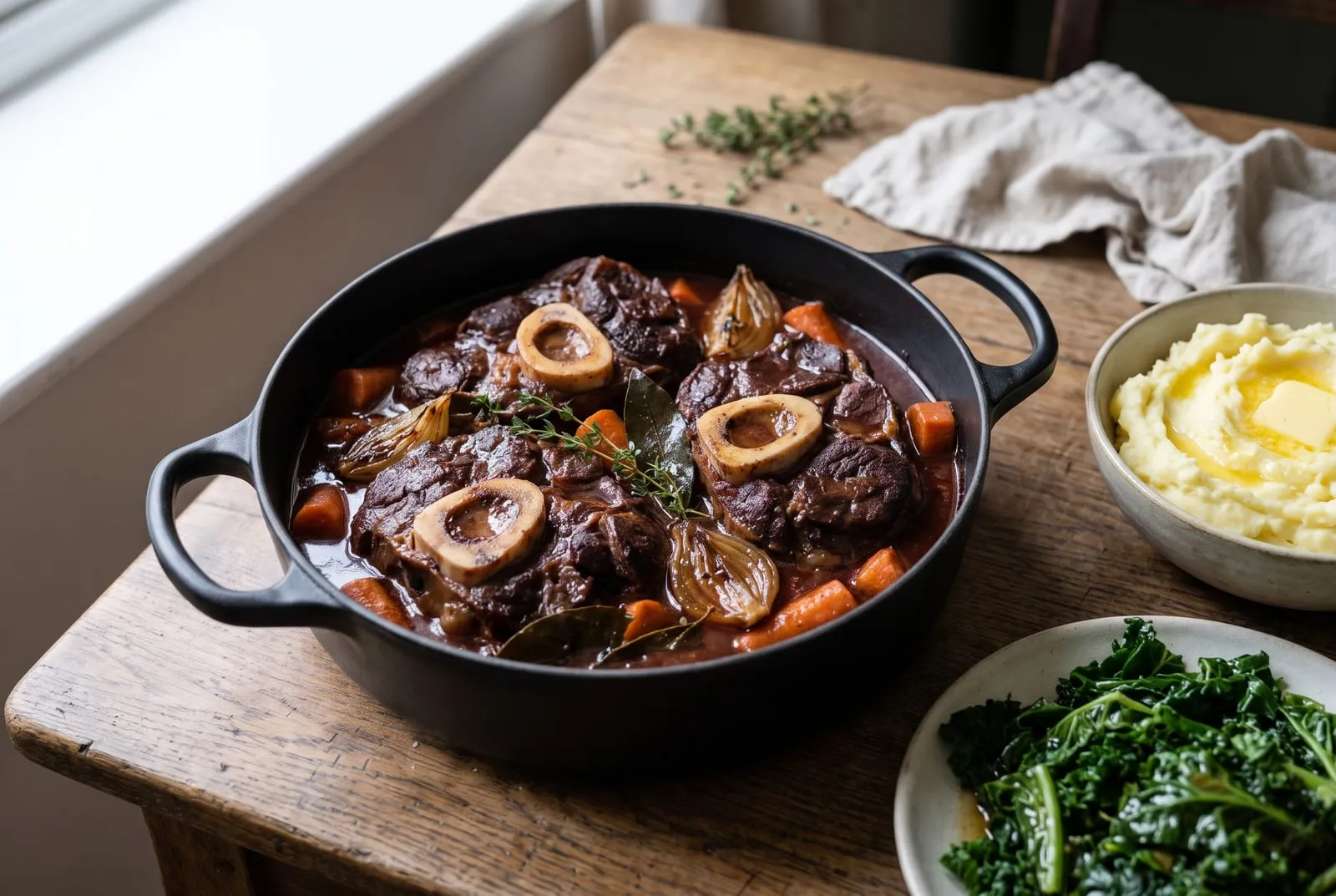
Braised beef shin with red wine
Beef shin, cut across the bone or boneless, browned and braised in red wine with onions, carrots and thyme for 3 to 3½ hours, until it falls apart.
-
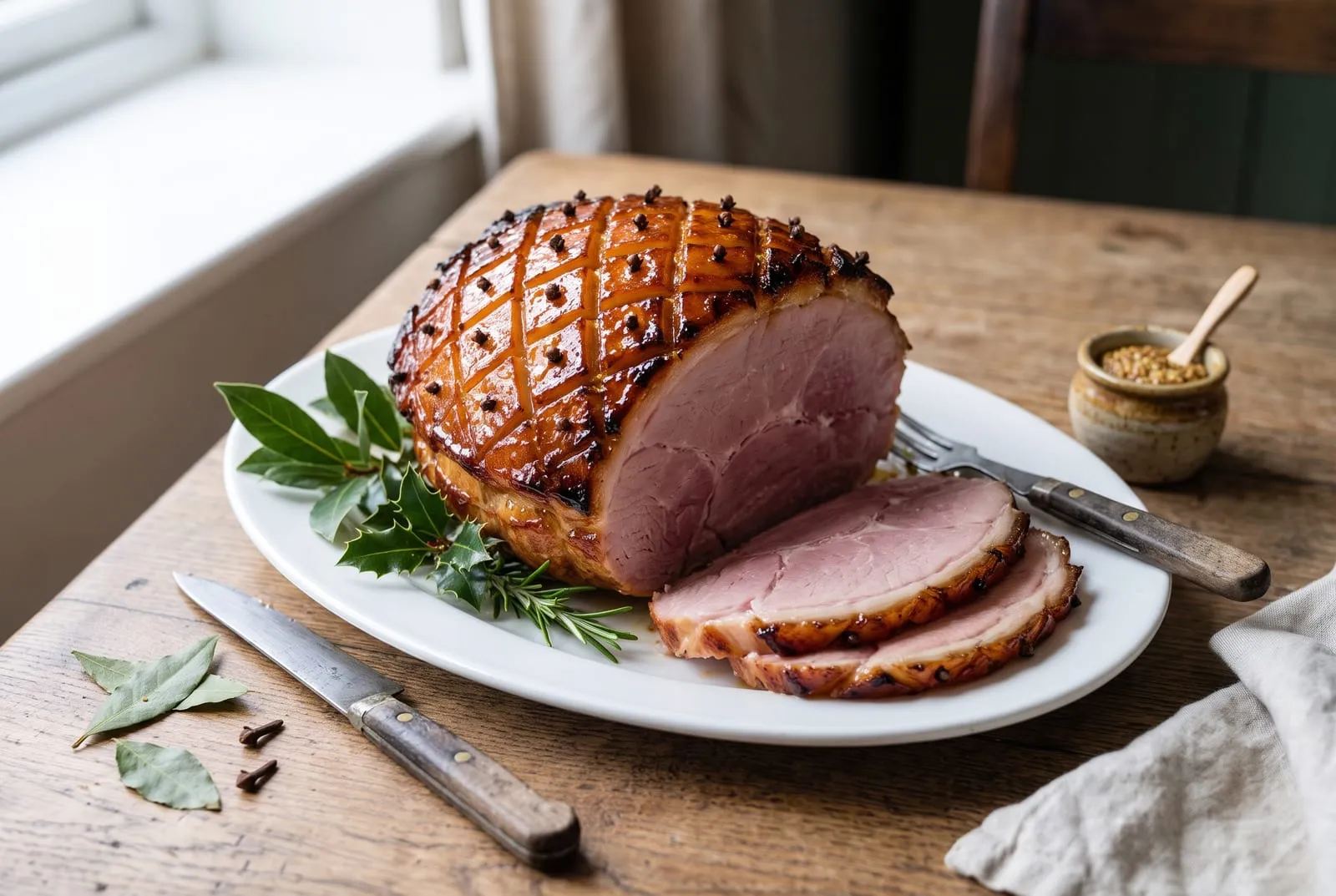
Christmas gammon: boiled and glazed
A cured gammon joint of 3 to 4 kg, simmered with onion, carrot, bay and cider, then scored, studded with cloves and baked with a honey and mustard glaze. Serves 10 to 12.
-
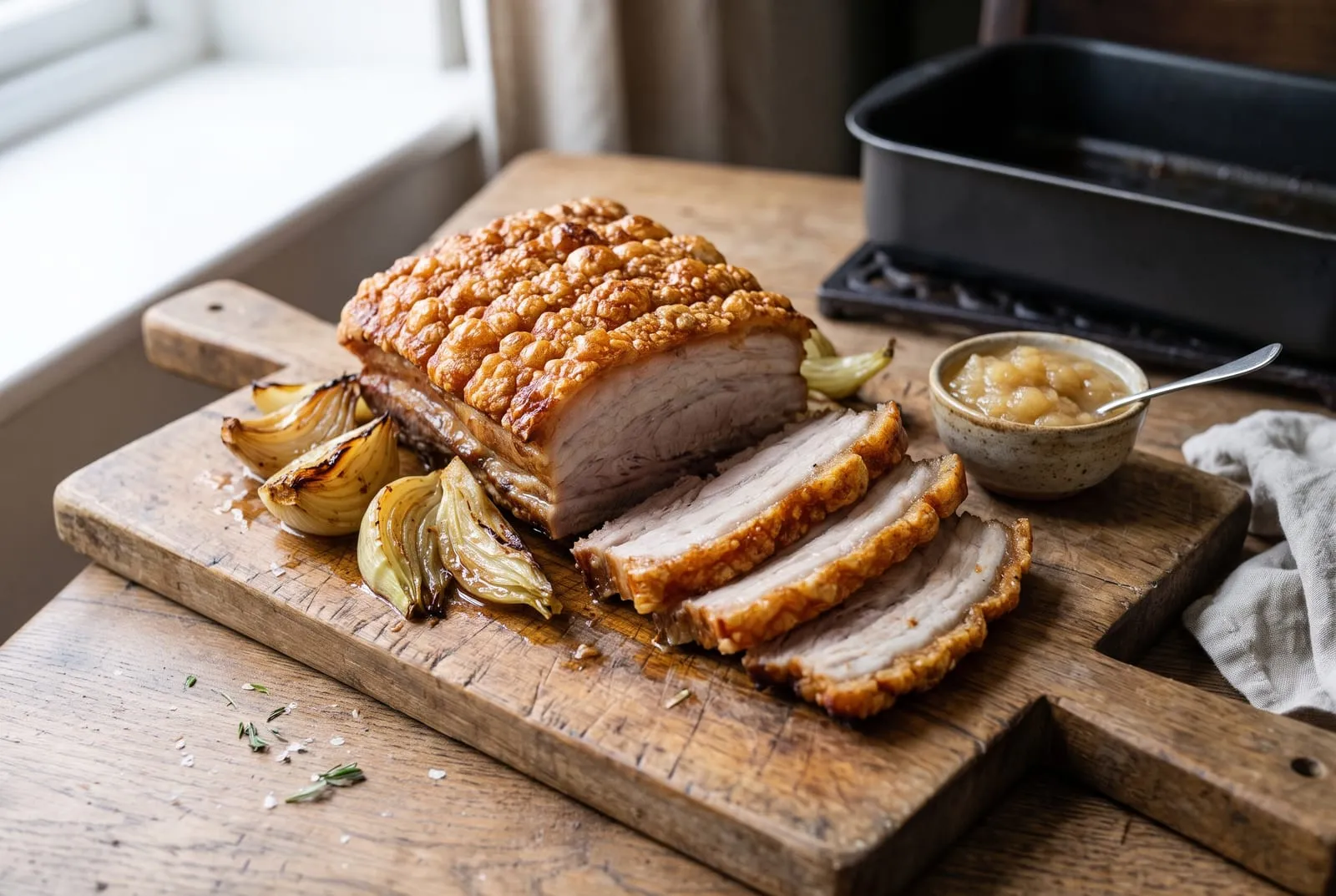
Slow-roast pork belly with crackling
A skin-on pork belly, dried overnight, salted and roasted low for about 2½ hours, then blasted hot for 20 to 30 minutes until the crackling blisters. Carve it skin side down.