Braised beef shin with red wine
Beef shin, cut across the bone or boneless, browned and braised in red wine with onions, carrots and thyme for 3 to 3½ hours, until it falls apart.
- Serves 6
- Prep 30 min
- Cook 4 hr 30 min
- Total 5 hr
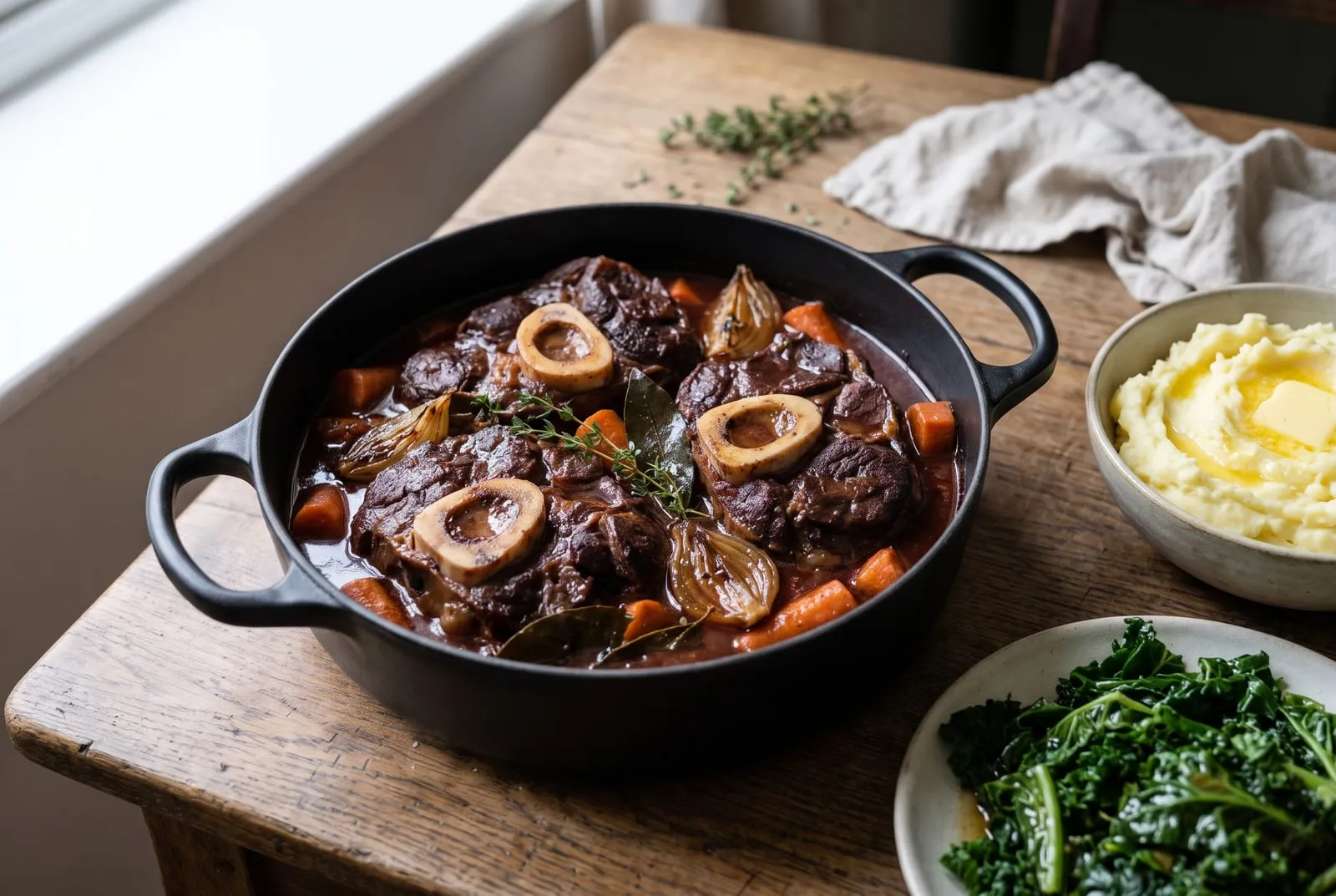
Braise beef shin for 3 to 3½ hours, covered, in red wine and stock at 150°C (130°C fan), gas 2, until it falls apart under a fork. Raw shin is tough, but long, wet heat turns its gristle and connective tissue into jelly, which thickens the sauce for you. It works with boneless chunks or thick slices cut across the bone.
Why shin
Shin comes from the leg, and the muscle works hard. Great British Chefs says that leaves it full of connective tissue and very tough, and adds that shin is generally a very cheap cut (Great British Chefs). AHDB says the gristle in shin turns into jelly when it’s cooked long and slow, which gives the rich beef flavour, and that shin thickens the sauce itself (AHDB). Swaledale, a butcher, says the collagen breaks down into gelatin and dissolves into the sauce (Swaledale). So you need little or no thickener.
Shin from your own beef
Shin is the lower leg, so a carcase has four, two in the forequarter and two in the hindquarter. For a 303 kg carcase (151.5 kg a side) after two weeks’ maturation, AHDB’s yield guide gives these boneless weights for one side, trimmed of excess fat, and the last column is our doubling (AHDB):
| Cut | Where | One side | Whole carcase |
|---|---|---|---|
| Fore shin | Forequarter | 2.05 kg | about 4.1 kg |
| Hind shin | Hindquarter | 2.58 kg | about 5.2 kg |
| Heel muscle | Hindquarter | 2.63 kg | about 5.3 kg |
The two shins together come to about 9 kg, or six batches of this recipe. AHDB calls the heel muscle ideal for slow cooking and similar to shin meat. It says the figures are a guide only, as carcase weights, types and butchery vary. For UK average carcase weights, see taking cattle to the abattoir.
On your cutting list. Put shin on your cutting list by name. Whatever isn’t listed as a joint or steak goes into mince, sausages or burgers, and the guide lists shin among the cuts for stewing or mince. Then say how you want it, with sizes in cm and weights in kg:
- Boneless, whole. The long muscles, with their connective tissue left in, to cut to size at home.
- Boneless, diced. Pieces of 4 to 5 cm, ready to brown.
- Across the bone. Slices 4 to 5 cm thick, which weigh more than boneless meat because of the bone. AHDB says shin on the bone can be cooked “osso buco” style.
This recipe uses 1.5 kg for six, so 750 g packs feed three. Ask for each pack to be labelled with the cut, weight and date.
The marrow. Each slice across the bone has a ring of marrow. Great British Chefs says it adds a wonderful richness and flavour to the sauce, and Swaledale says it melts out and adds savoury depth.
If you haven’t booked the kill yet, start with the abattoirs that take cattle and our guide to booking private kill.
Buying shin if you don’t keep cattle
Ask a butcher, a farm shop or a farm that sells its own beef. AHDB says shin is sold as bone-in or boneless medallion-shaped pieces, and Great British Chefs adds that it comes in whole pieces or diced. Give a few days’ notice for slices across the bone, and ask the weight and thickness. Slices on the bone carry the weight of the bone, so buy a little over 1.5 kg.
If you can’t find shin, AHDB says beef leg is very similar and a great cut for slow cooking (AHDB), and its shin page suggests braising steak or oxtail to slow cook or braise.
Hanging
Hang the carcase for the steaks and roasting joints, not the shin. AHDB’s minimum hanging times are for grilling, roasting and frying cuts: at least 7 days for hindquarter cuts and 14 for forequarter cuts from steers and heifers, with 21 days for the best tenderness. It says only those cuts benefit from more than a week (AHDB). A shin that will braise for hours doesn’t need the longer hang. Our guide to how long to hang meat has the detail.
At home, keep raw shin on the bottom shelf of the fridge, or freeze it. Thaw it in the fridge, so take it out the day before, and use it within 24 hours of it thawing fully (FSA).
Cooking notes
- Prep. Pat the shin dry so it browns rather than steams. Trim dried-out edges, but leave the connective tissue in, because it softens and thickens the sauce.
- Browning. Brown in batches, as Great British Chefs advises, so the pan stays hot. Shake off loose flour first, or it burns on the base of the pot. The flour is optional: for a gluten-free braise leave it out, check the stock label, and reduce the sauce a little longer.
- Low and slow. The liquid should barely tremble. Lower the oven if it’s bubbling hard, and top up with hot water if it drops below halfway up the meat.
- When it’s done. The time is a guide. It’s ready when the meat falls apart under a fork, as Great British Chefs and Swaledale both describe. If it resists, give it 30 minutes more.
- Food safety. The FSA says food is fully cooked when the middle reaches 70°C for 2 minutes. Whole cuts of beef can be pink once seared, but mince and rolled joints must be cooked all the way through (FSA). A shin braised for 3 hours or more is far past that, so tenderness, not safety, sets the time.
- Skimming. Swaledale says shin has very little fat, but the browning oil and any marrow end up in the pot. Spoon the fat off before you boil the sauce down, or it boils back in. If you cook a day ahead, chill the pot and lift the set fat off.
- Seasoning. Stock and the reduced sauce both concentrate salt, so taste only at the end.
Leftovers and freezing
The FSA’s advice on leftovers (FSA):
- Cool them at room temperature and get them into the fridge within one to two hours. Smaller portions in containers or freezer bags cool faster. Eat them within 48 hours, or freeze them.
- Frozen meat is usually best eaten within 2 to 3 months. Food can be frozen again once it’s cooked, so braise made from shin that was frozen raw can go back in the freezer, but it can then be reheated only once, until steaming hot all the way through (FSA).
Take out any bones while the meat is warm, and keep it in its sauce, which stops it drying out. Cold, the sauce sets like jelly: that’s the gelatine, and it melts as it heats. Then use it in:
- A pie. Chop or shred the meat, mix it with the sauce, cool it completely and top with shortcrust or puff pastry. Bake until the filling is steaming hot all the way through. To freeze one, assemble it with cold filling and freeze it before baking, so the baking is its only reheat.
- A ragu. Shred the meat into the sauce with a tin of chopped tomatoes, simmer until thick and serve with pappardelle or polenta.
- The freezer. Freeze portions covered in sauce, labelled with the date.
Each of these uses the meat’s one reheat, so eat them up. Swaledale says shin often tastes better the next day, but if you braise it a day ahead, warming it for the meal is its reheat, so freeze any spare portions before you warm it.
Serving
Buttery mash takes up the sauce, and so do soft polenta and buttered noodles. Add buttered kale, cavolo nero or Savoy cabbage, and something sharp to cut the richness: horseradish, or a gremolata of chopped parsley, lemon zest and a little raw garlic. With bone-in slices, put a small spoon and some toast on the table for the marrow. For other slow cuts, see our slow-cooked venison shoulder and slow-roast mutton shoulder.
Braised beef shin with red wine
- Serves 6
- Prep 30 min
- Cook 4 hr 30 min
- Total 5 hr
Ingredients
- 1.5 kg beef shin, in slices 4 to 5 cm thick cut across the bone, or boneless
- 3 tbsp plain flour
- Salt and black pepper
- 3 tbsp rapeseed or sunflower oil
For the braise
- 2 onions, cut into thick wedges
- 3 carrots, cut into 3 cm chunks
- 2 celery sticks, finely chopped
- 4 garlic cloves, sliced
- 2 tbsp tomato purée
- 400 ml dry red wine
- 500 ml beef stock
- 6 thyme sprigs
- 2 bay leaves
Method
- Heat the oven to 150°C (130°C fan), gas 2. Pat the shin dry with kitchen paper. If it is in slices on the bone, snip any tough outer membrane in 2 or 3 places so the slices keep their shape. If it is boneless, trim off any dried-out edges, leaving the connective tissue that runs through the meat, and cut it into 5 cm chunks.
- Mix the flour with ½ tsp salt and plenty of black pepper on a plate. Turn the shin in the flour until it is lightly coated all over, then shake off the excess.
- Heat 1 tbsp of the oil in a flameproof casserole of about 4 litres over a medium-high heat. Brown the shin in 2 or 3 batches, in a single layer with space between the pieces, for 8 to 10 minutes a batch, turning it until it is deep brown on all sides. Lift each batch onto a plate, adding a little more oil if the pan looks dry. If the flour left in the base starts to burn, wipe it out with kitchen paper before the next batch.
- Turn the heat down to medium and add a little more oil if the pot is dry. Add the onions, carrots and celery and cook for about 10 minutes, stirring now and then, until the onions have softened and started to colour at the edges. Stir in the garlic and tomato purée and cook for 1 to 2 minutes, until the purée darkens.
- Pour in the wine and scrape up the browned bits from the base of the pot. Let it bubble for 3 to 4 minutes, until it has reduced by about a third, then add the stock, thyme and bay leaves and bring to a simmer.
- Return the shin and any juices from the plate to the pot, pushing the pieces down into the vegetables. The liquid should come about halfway up the meat, so add a little hot water if it doesn't. Cover with a sheet of foil and then the lid, so it seals well, and put it in the oven.
- Braise for 3 to 3½ hours, turning the meat over halfway through. It is ready when the meat falls apart under a fork and, on bone-in slices, has started to pull away from the bone. If it is still firm, cover it again and give it another 30 minutes.
- Lift the shin onto a warm dish with a slotted spoon, using a fish slice for bone-in slices, and cover it loosely with foil. Leave the sauce to settle for a few minutes, then tilt the pot and spoon the fat off the top. Fish out the bay leaves and thyme stalks.
- Boil the sauce on the hob over a high heat for 10 to 15 minutes, until it has reduced by about a third and coats the back of a spoon. Taste and season with salt and pepper. Return the meat to the sauce, or spoon the sauce over it, and serve.
What you'll need
- Cast-iron casserole dish Goes from hob to oven, and holds a steady heat for long, slow cooking.
- Locking kitchen tongs Turns and lifts browned pieces without piercing them.
- Marrow spoon A long, thin scoop for the marrow in bone-in slices.
- Freezer containers Freeze leftovers in portions, covered in their sauce.
These are Amazon links. If you buy through them, Lairage may earn a small commission at no extra cost to you.
Questions people ask
How long does beef shin take to cook?
About 3 to 3½ hours, covered, at 150°C (130°C fan), gas 2, for 1.5 kg of shin. Go by the meat rather than the clock. It's ready when it falls apart under a fork, and bone-in slices have started to pull away from the bone. If it's still firm, cover it again and give it another 30 minutes.
Why is my beef shin still tough?
Almost always because it hasn't had long enough. Shin is full of connective tissue, which only turns soft after hours of gentle, wet heat, so meat that's still chewy after 2 hours isn't ruined. Put the lid back on and check it every 30 minutes, keeping the liquid about halfway up the meat and at a bare simmer rather than a boil.
Is beef shin better on the bone or boneless?
Either works. Slices cut across the bone hold their shape and bring marrow to the sauce, in the style of osso buco, but you pay for the weight of the bone. Boneless shin gives more meat per kilo and is easier to cut and portion. This recipe uses the same time for both.
Can you cook beef shin in a slow cooker?
Yes, if it fits. Brown the meat and soften the vegetables in a pan first, because a slow cooker won't brown them. Use less liquid, because very little evaporates, and cook on low until the meat falls apart, following your slow cooker's instructions on timing. Boil the sauce in a pan afterwards to reduce it.
Can you freeze braised beef shin?
Yes. Cool it, get it into the fridge within 1 to 2 hours, then freeze it in portions covered with sauce. The FSA says frozen meat is usually best eaten within 2 to 3 months. Defrost it in the fridge, use it within 24 hours of it thawing fully, and reheat it only once, until steaming hot all the way through. Food can be frozen again once it's cooked, even if the shin was frozen raw, but it can then be reheated only once.
Sources
- Food Standards Agency: Cooking your food
- Food Standards Agency: How to chill, freeze and defrost food safely
- AHDB (EBLEX): Direct Facts 1, Maturation for improved beef and lamb
- AHDB: Beef yield guide, animal to carcase, to primals, to muscles
- Simply Beef & Lamb (AHDB): Beef shin
- Simply Beef & Lamb (AHDB): Beef leg
- Great British Chefs: How to cook beef shin
- Swaledale: How to cook diced shin of beef
This recipe is general information. Follow the Food Standards Agency's advice on cooking meat safely, and on eating game shot with lead if you eat it often.
More recipes
-
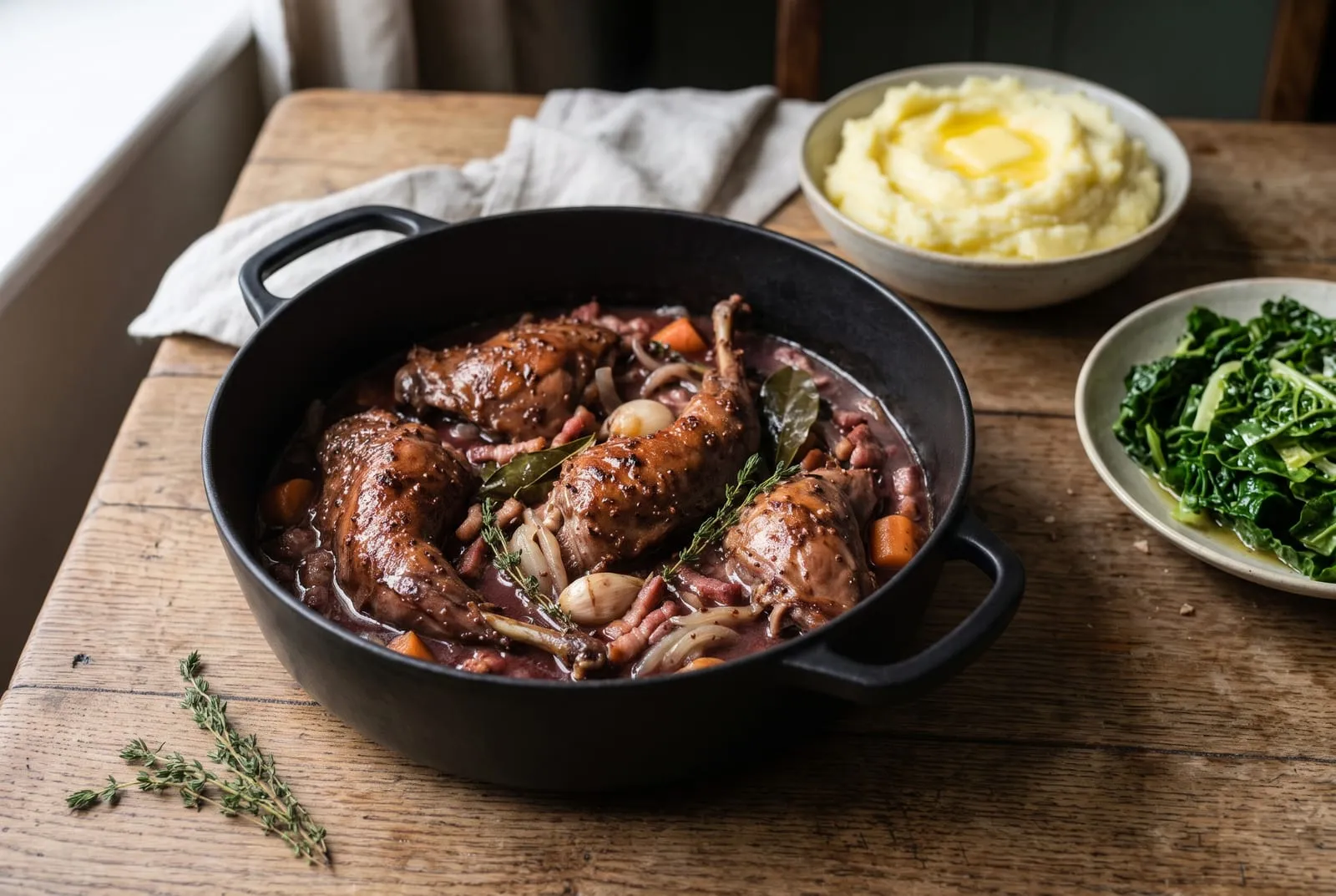
Braised pheasant legs with bacon and red wine
Eight pheasant legs braised in red wine with smoked bacon until the meat falls off the bone, with the hard tendons picked out. Cooked all the way through, as the FSA advises for game birds.
-
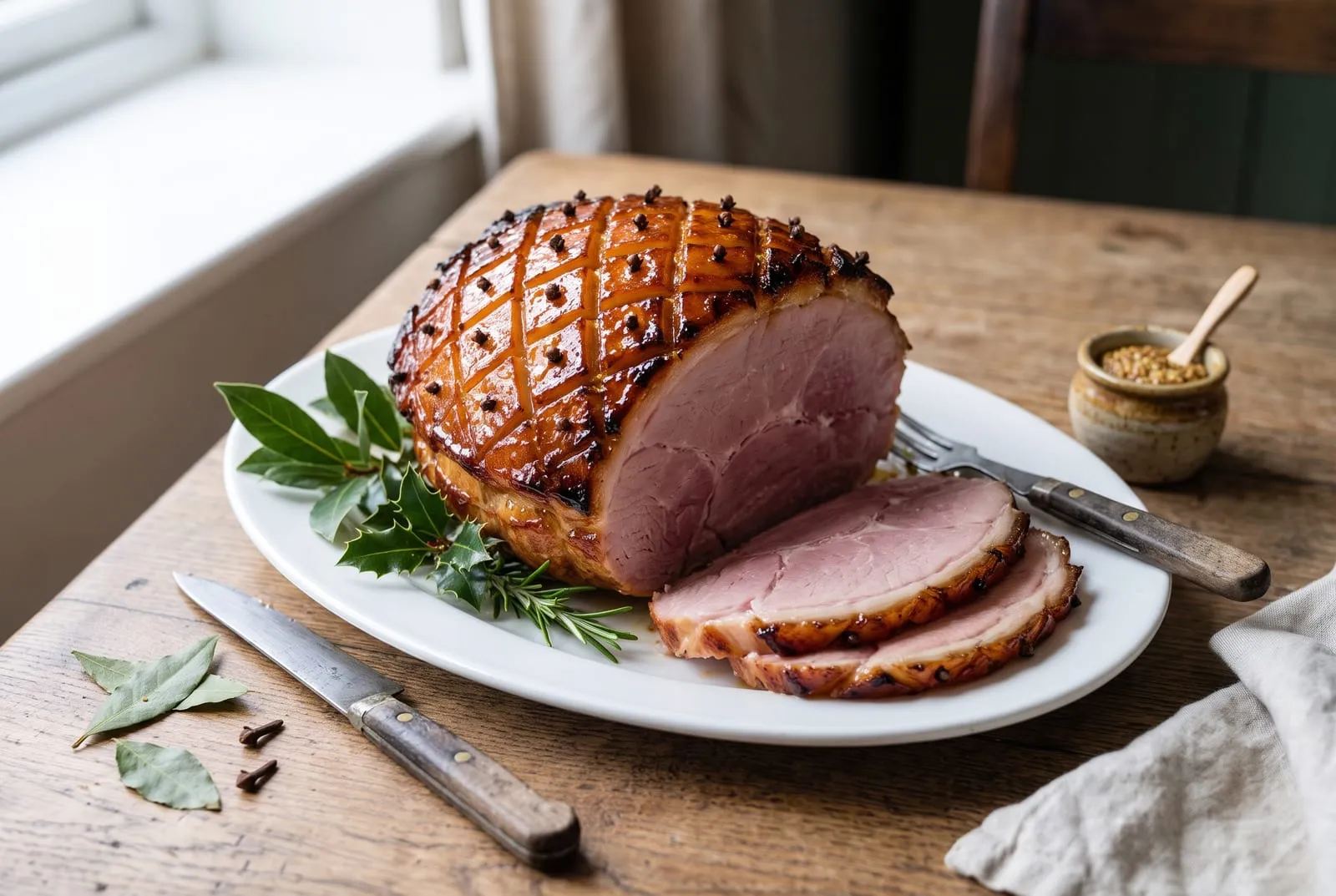
Christmas gammon: boiled and glazed
A cured gammon joint of 3 to 4 kg, simmered with onion, carrot, bay and cider, then scored, studded with cloves and baked with a honey and mustard glaze. Serves 10 to 12.
-
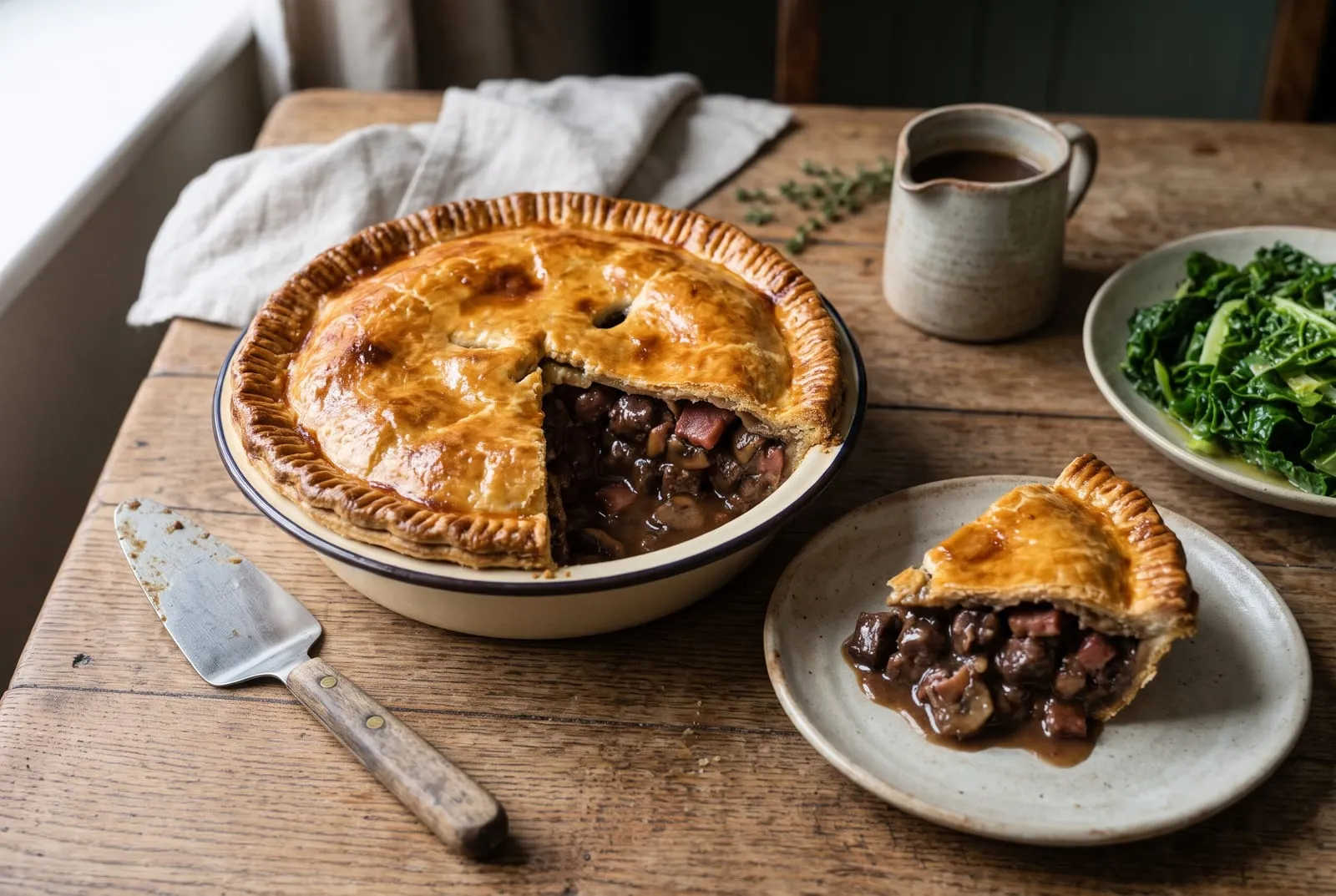
Game pie with venison and pheasant
Diced venison shoulder and pheasant slow-cooked in red wine with smoked bacon, mushrooms and juniper, cooled, then baked under a pastry lid. Freeze it unbaked to keep it.