Private kill in Scotland: abattoirs, ScotEID paperwork and venison
Private kill in Scotland works the same way as in England and Wales: an approved slaughterhouse kills your animal and gives you back the carcase or the cut meat. What differs is how few abattoirs take private animals, how far you may have to travel, the paperwork, which all runs through ScotEID, and the venison rules. Book early, check the abattoir still takes your species, and have your ScotEID details to hand.
How many abattoirs take private kill
The Scottish Animal Welfare Commission (SAWC) published a report on abattoir provision in November 2025. It found:
- 24 licensed abattoirs in Scotland in January 2025: 22 for red meat and 2 for poultry.
- 12 of them offered private kill, mostly the smaller ones.
- Scotbeef announced the closure of its Inverurie abattoir in June 2025, and four other red meat abattoirs had closed since 2020.
- Journeys in parts of Caithness, Sutherland, Ross and Cromarty and Argyll and Bute can be over 100 miles.
- Several small Scottish abattoirs only open in certain seasons.
Our Scotland listing covers the 31 slaughterhouses and game handling establishments on the Food Standards Scotland approved list, with what we know about which take private kill.
The island abattoirs
Six of the abattoirs in the SAWC report are on islands. All six are small, kill cattle, sheep and pigs, and offered private kill:
| Island | Abattoir in the SAWC report |
|---|---|
| Shetland | Shetland abattoir |
| Lewis | Run by the Western Isles Council (Stornoway) |
| Barra | Barra abattoir |
| North Uist | Lochmaddy abattoir |
| Mull | Mull abattoir |
| Islay | Avonvogie abattoir |
If you keep stock on an island, these are usually the nearest option. Ask about kill days well ahead, because a small plant may only kill on set days or in certain months.
Capacity is tight
- Millers of Speyside, at Grantown-on-Spey, stopped private kill for sheep and pigs from the start of 2025 and now kills cattle only (Press and Journal, December 2024).
- The SAOS report. In May 2024 the Scottish Agricultural Organisation Society (SAOS) published its Scottish Small Producer Access to Abattoirs report. About 40% of the producers surveyed said the limited private kill network restricted what they could process. It found most mainland abattoirs treat private kill as a sideline, and SAOS worked with Munro’s of Dingwall to understand what private kill costs an abattoir to provide.
- Small Producers Pilot Fund. The Scottish Government’s fund gave £256,500 to private kill abattoirs in Shetland, Wishaw, Barra, Dingwall and Mull (gov.scot, February 2025). In March 2026 the Rural Affairs Secretary said over £400,000 had gone into small-scale private kill that year, including co-ordination work by Quality Meat Scotland, and that the fund, worth £1.5 million, would triple its capital grants for smaller producers (gov.scot).
- Help from QMS. Quality Meat Scotland has a private slaughter co-ordinator, and its Private Kill Handbook for Scottish Farmers (November 2025) walks through booking, paperwork and butchery.
In practice: book as soon as you know when your animals will be ready, ask to go on a cancellation list, and allow for ferry times and costs. Our booking checklist lists the questions to ask.
Paperwork in Scotland
Scotland has its own livestock traceability system, ScotEID. The English Livestock Information Service, EIDCymru and, for moves starting in Scotland, eAML2 don’t apply.
| Animal | What you need |
|---|---|
| Cattle | Two official ear tags and the passport, issued by ScotEID. Moves are reported to ScotEID, not BCMS |
| Sheep and goats | A movement document, on paper or electronically through ScotEID. Lambs and kids for slaughter before 12 months can have a single electronic slaughter tag showing your flock mark |
| Pigs | Notify the move to ScotEID before it happens or on the day. Mark pigs with your herd mark |
Sources: gov.scot cattle, sheep and goats, pigs, QMS handbook.
Cattle
Since ScotMoves+ launched on 4 October 2021, ScotEID has issued cattle passports for the Scottish Government, and Scottish keepers report births, movements and deaths to ScotEID rather than BCMS. Report a move within 3 days, through ScotMoves+, the ScotEID website or by phone, and update your holding register within 48 hours. When cattle go to a Scottish abattoir, the abattoir reports both the move off your farm and the move onto its premises electronically. Check that it has; if not, you must notify ScotEID yourself (gov.scot).
BCMS and CTS only come into it if you also keep cattle on a holding in England or Wales. See taking cattle to the abattoir for TB, the over-30-month change and beef shares.
Sheep and goats
Before the journey, complete a movement document. The Scottish Government’s paper form comes in three parts: you keep one copy, and the other two travel with the animals. The receiving keeper notifies the Scottish Animal Movement Unit (SAMU) within 3 days. Record the move in your holding register within 48 hours (gov.scot). QMS says you can also complete the movement electronically through ScotEID.
Lambs and kids going for slaughter before they are 12 months old can carry a single electronic slaughter tag showing your flock mark, and are recorded on the movement document as a batch (gov.scot). EID is voluntary for goats unless they’re for export. More in taking sheep and goats to the abattoir.
Pigs
Notify every pig move to ScotEID before it happens or on the day, online, by phone or in writing. If you notify online or by phone you don’t need a separate movement document, except for pigs under 12 months old on a temporary mark and pigs going to England, Wales or Northern Ireland. If you notify in writing, a copy of your movement document must travel with the pigs. The receiving keeper confirms arrival within 3 days (gov.scot). Record the move in your holding register within 48 hours. More in taking pigs to the abattoir.
Food chain information
Every animal needs food chain information (FCI), as in England and Wales. For sheep and goats it’s built into the Scottish movement document, and for pigs you can add it to the ScotEID movement document. For cattle, use the abattoir’s own form or the model document from Food Standards Scotland. FCI can travel with the animals or reach the abattoir up to 24 hours before (Business Companion). If animals arrive without it, the official vet decides whether slaughter can go ahead, and the carcases aren’t passed for human consumption until the FCI arrives (Food Standards Scotland).
Crossing the border
If you take animals from Scotland to an abattoir in England, or the other way, ask the abattoir which movement document and FCI form it wants. Pigs leaving Scotland need a movement document with them, even if the move was notified online.
Selling venison: the dealer’s licence
This is the biggest difference from England and Wales, where game dealer licences were abolished in 2007.
In Scotland, under section 36 of the Deer (Scotland) Act 1996, it’s an offence to sell venison, offer it for sale, or keep or transport it for sale, unless you:
- hold a venison dealer’s licence from your council, or
- are selling to a licensed venison dealer, or
- bought the venison from a licensed venison dealer.
Food Standards Scotland’s Wild Game Guide puts it simply: at least one party to the sale must hold a licence. You don’t need one if you only keep the deer you shoot for your own household. Licences come from your council, last three years (section 33), and fees vary: Argyll and Bute charges £237.20. Licensed dealers must keep a register of the venison they buy and who from.
Change on the way. The Natural Environment (Scotland) Act 2026, which received Royal Assent on 12 March 2026, will repeal the venison dealer’s licence. That section only takes effect when Scottish Ministers make commencement regulations. It wasn’t in the package the Cabinet Secretary listed for October 2026 (letter of 30 July 2026), so in November 2026 the licence is still needed. Check with your council before you sell.
The food hygiene side is much as in England and Wales. You can supply small quantities of deer in the skin to final consumers or local shops, restaurants and butchers, and you must register with your council if you skin or butcher it first. FSS defines local as your own council area, a neighbouring one, or 50 km from your council’s boundary. For the island councils, local means the whole of Scotland. See deer and wild game processing and the deer handlers we list.
Home slaughter in Scotland
Food Standards Scotland’s home slaughter guidance (May 2024) sets out the law in Scotland. In short:
- You can kill your own livestock on your own property, for you and members of your immediate household living there.
- The owner can do it, or someone holding a certificate of competence can do it under the owner’s responsibility and supervision. Using anyone else is unlawful.
- The carcase can’t be taken anywhere else to be processed, other than parts sent for disposal as animal by-products.
- You can’t sell the meat, serve it to bed and breakfast guests, or supply anyone outside the household, including business partners.
- The welfare rules are the Welfare of Animals at the Time of Killing (Scotland) Regulations 2012. Outside an abattoir, APHA enforces them with the council. Only permitted stunning methods may be used, and an owner killing for their own use doesn’t need a certificate of competence.
- For cattle, sheep and goats, specified risk material must be removed, stained and sent for rendering or incineration.
- Religious slaughter is only allowed in an approved slaughterhouse.
- As good practice, FSS advises telling your council before a home slaughter, or within 5 days if you can’t.
FSS also says a home kill is likely to carry more risk to your health than slaughter at an approved abattoir. For the wider rules, see home slaughter and the law.
Selling meat from private kill
If you want to sell the meat, the animal must be killed at an approved slaughterhouse. Register as a food business with your council’s environmental health service at least 28 days before you start (Food Standards Scotland). The rest is covered in selling your own meat.
Find an abattoir in Scotland
Start with the Scotland listing, then phone or send an enquiry to check kill days, species and prices. Our guides to private kill prices and cutting lists help you compare and plan.
Questions people ask
How many abattoirs in Scotland do private kill?
The Scottish Animal Welfare Commission counted 24 licensed abattoirs in Scotland in January 2025, 22 for red meat and 2 for poultry. Twelve offered private kill, mostly the smaller ones, including six small abattoirs on Shetland, Lewis, Barra, North Uist, Mull and Islay. Scotbeef's Inverurie plant has closed since then.
Are cattle movements in Scotland still reported to BCMS?
No. Since 4 October 2021 Scottish keepers report cattle births, movements and deaths to ScotEID, using ScotMoves+, the ScotEID website or the phone, and ScotEID issues the passports. When cattle go to a Scottish abattoir, the abattoir reports the move off your farm and onto its premises for you, but check that it has.
Do you need a licence to sell venison in Scotland?
Yes, as of November 2026. Under the Deer (Scotland) Act 1996 it's an offence to sell venison unless you hold a venison dealer's licence from your council, sell to a licensed dealer, or bought it from one. The Natural Environment (Scotland) Act 2026 will repeal the licence, but that section wasn't yet in force in November 2026.
Do pigs need eAML2 in Scotland?
Not for a move that starts in Scotland. You notify ScotEID before the move or on the day, online, by phone or in writing. If you notify online or by phone you don't usually need a paper movement document, but you do for pigs under 12 months on a temporary mark and for pigs going to England, Wales or Northern Ireland.
Can I kill my own animals at home in Scotland?
Yes, on your own property, for you and your immediate household living there. Food Standards Scotland says the owner can do it, or a holder of a certificate of competence working under the owner's supervision. The meat can't be sold or given to anyone else, and the carcase can't be taken elsewhere to be processed.
Useful kit
- Large cool boxes Keeps meat cold on the drive home from the abattoir.
- Chest freezer A half pig or whole lamb needs about 100 to 150 litres.
- Vacuum sealer and bags Stops freezer burn if the butcher packs in plain bags.
- Freezer labels and marker Cut, weight and date on every pack.
These are Amazon links. If you buy through them, Lairage may earn a small commission at no extra cost to you.
Sources
- Scottish Animal Welfare Commission: Abattoir provision and opportunities for mobile slaughterhouses in Scotland, background and Table 1 (20 November 2025)
- Scottish Animal Welfare Commission: Abattoir provision report, outcomes of evidence gathering (20 November 2025)
- Scotland Food & Drink: SAOS abattoir survey results, Scottish Small Producer Access to Abattoirs report (6 May 2024)
- Press and Journal: North abattoir takes pork and lamb off menu to focus purely on beef (16 December 2024)
- Scottish Government: Supporting Orkney's farmers and food producers (11 February 2025)
- Scottish Government: Quality Meat Scotland conference, Rural Affairs Secretary speech (10 March 2026)
- Quality Meat Scotland: Private Kill Handbook for Scottish Farmers (November 2025)
- Scottish Government: Livestock identification and traceability guidance, cattle (updated 1 July 2026)
- Scottish Government: Livestock identification and traceability guidance, sheep and goats
- Scottish Government: Livestock identification and traceability guidance, pigs (updated 1 July 2026)
- Scottish Government: Sheep and goat identification and traceability, guidance for keepers in Scotland
- Scottish Government: Pig identification and registration, guidance for keepers in Scotland, movements
- Food Standards Scotland: Food chain information
- Business Companion: Food chain information (Scotland), updated June 2026
- Deer (Scotland) Act 1996, section 33: licences to deal in venison
- Deer (Scotland) Act 1996, section 36: offences in connection with dealing in venison
- Natural Environment (Scotland) Act 2026, section 39: removal of venison dealing licensing (prospective)
- Cabinet Secretary for Climate Action and Rural Affairs: Natural Environment (Scotland) Act 2026, update on commencement (30 July 2026)
- Food Standards Scotland: The Wild Game Guide
- Argyll and Bute Council: Venison dealer's licence
- Food Standards Scotland: Home slaughter guidance, a guide to the law in Scotland (May 2024)
- The Welfare of Animals at the Time of Killing (Scotland) Regulations 2012
- Food Standards Scotland: Registering a food business
This guide is general information, not legal advice. It's written for Great Britain: rules differ between England, Scotland and Wales and change over time, so check with your abattoir, vet or local council if you're unsure. In Northern Ireland the Food Standards Agency and DAERA set the rules, and in the Republic of Ireland the Department of Agriculture, Food and the Marine does. Prices here are in pounds; abattoirs in the Republic charge in euros and set their own prices.
Cook it
-
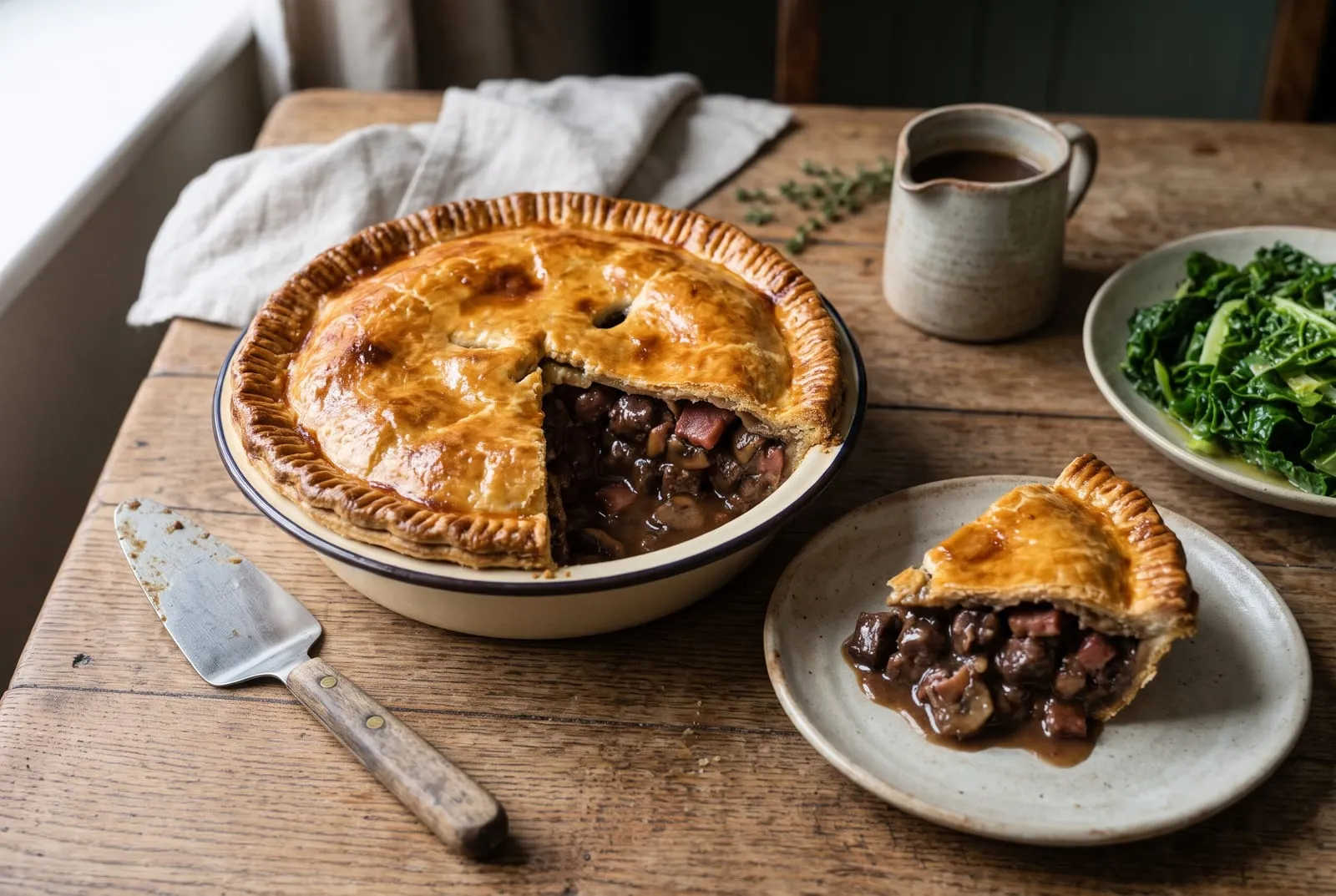
Game pie with venison and pheasant
Diced venison shoulder and pheasant slow-cooked in red wine with smoked bacon, mushrooms and juniper, cooled, then baked under a pastry lid. Freeze it unbaked to keep it.
-
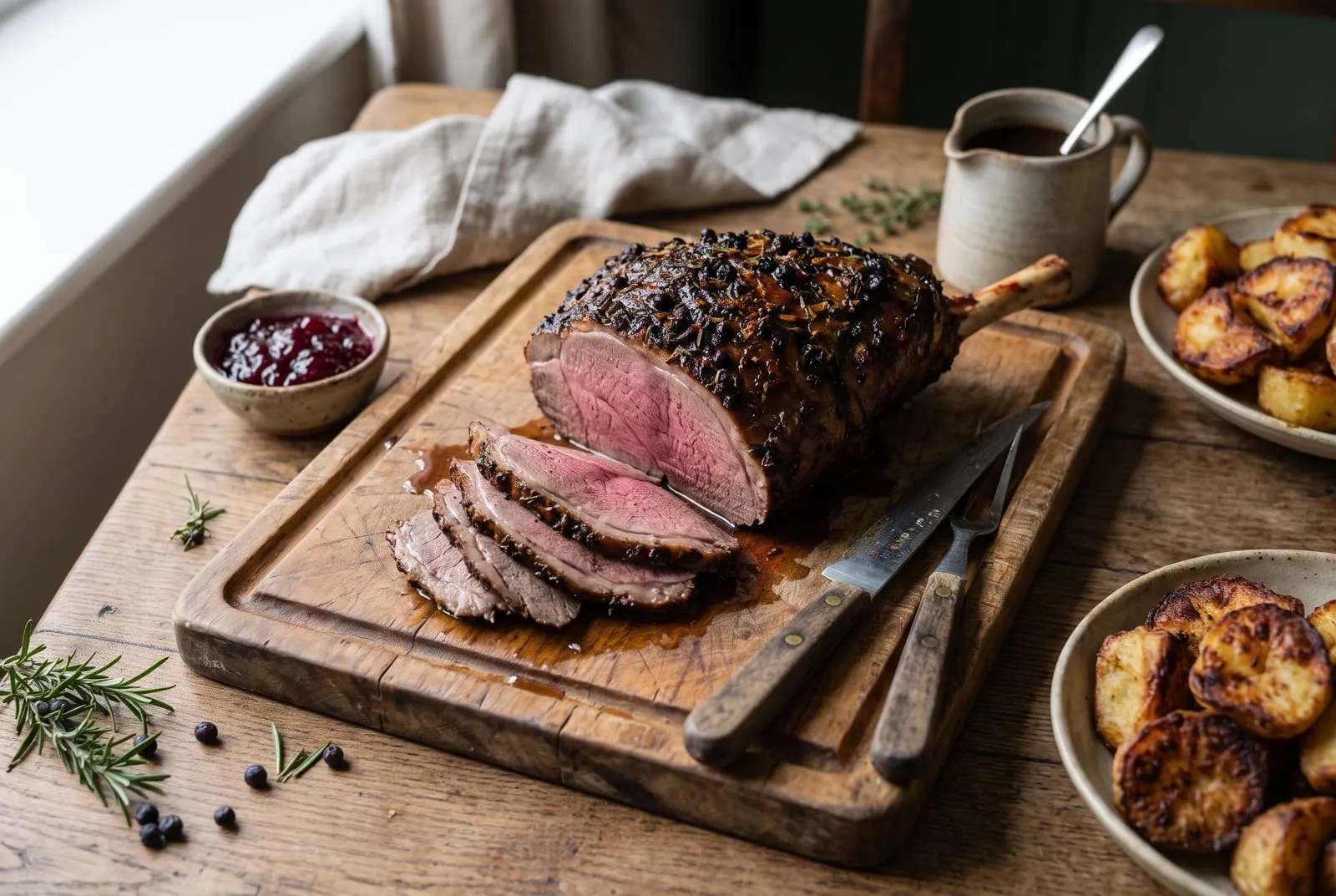
Roast haunch of venison with juniper and bacon
A whole bone-in venison haunch, seared, rubbed with juniper, garlic and rosemary and wrapped in bacon, then roasted pink and rested for 30 minutes. Enough for 6 to 8, with a port and redcurrant gravy.
-
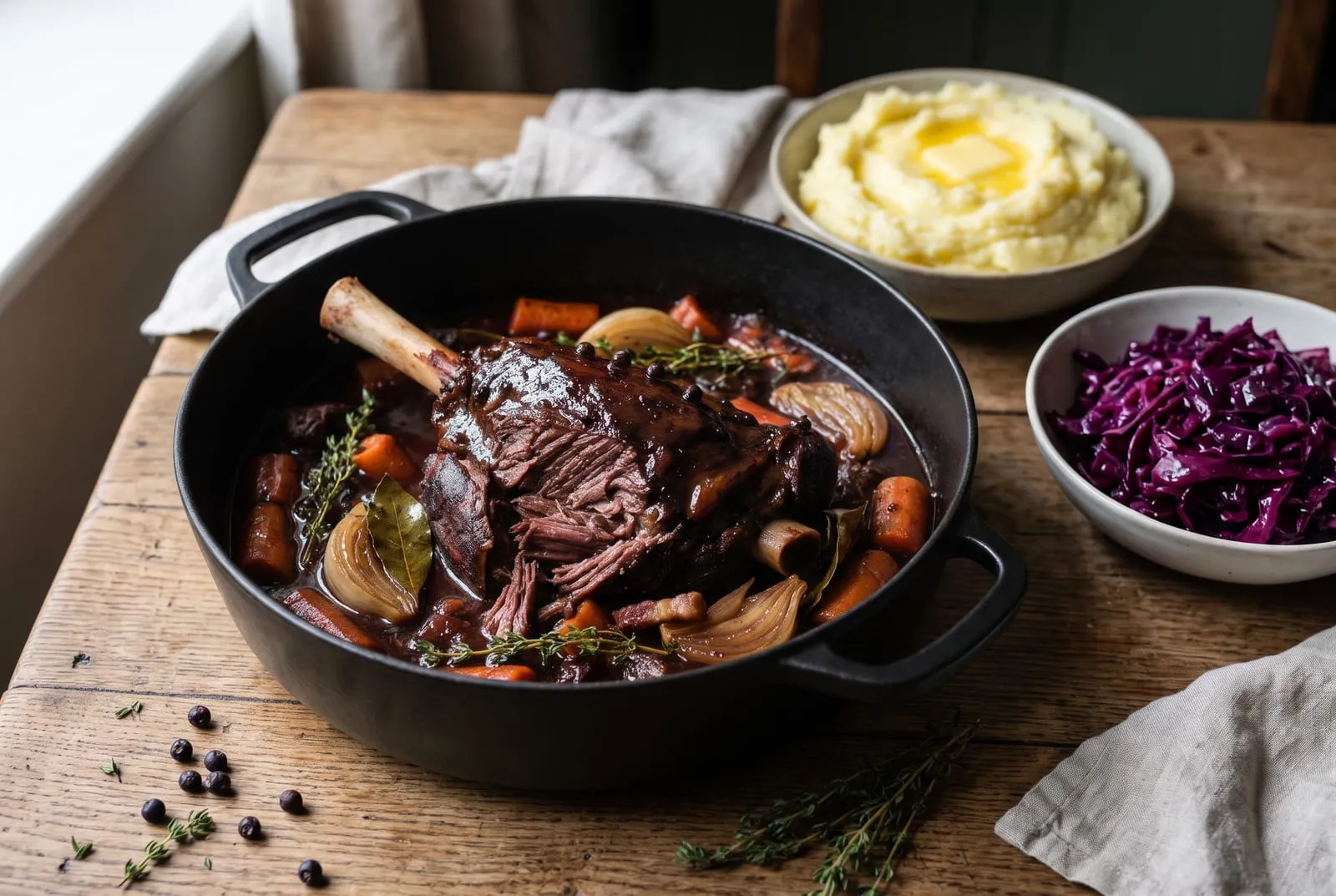
Slow-cooked venison shoulder with red wine and juniper
A bone-in venison shoulder braised for 3½ to 4 hours in red wine with juniper, bay and smoked bacon, until the meat falls off the bone. Fallow is a good size, or use two roe shoulders.